

Putting. It is the one stroke in golf that admits all applicants without prejudice. It does not inquire into age, athletic pedigree, or anatomical fortune. It requires neither speed nor strength, neither fast-twitch musculature nor heroic violence. It asks only that a small white ball be persuaded – with minimal ceremony – to travel across a patch of grass toward a distant hole. It is, in this sense, the game’s most democratic act and, not coincidentally, its most psychologically treacherous.
Putting the great equalizer and the great betrayer. It is the point at which the game slows to such a degree that the mind, finding itself suddenly unoccupied, begins interfering with its own proceedings. Hence the enduring maxim drive for show, putt for dough – a phrase as inelegant as it is irrefutable. And like all truths that resist refinement, it has become the object of relentless and largely misguided improvement.
The Disappearance of the Blade
One need only wander into a modern golf retailer to observe the consequences. These vast, fluorescent-lit temples of consumer optimism present their wares with the confidence of institutions that believe progress to be both measurable and purchasable. Yet what is most striking is not what is present, but what has quietly vanished.
The blade putter.
Once the understated instrument of serious golfers, the blade has been exiled its lineage of restraint and proportion displaced by objects that resemble either spacecraft docking mechanisms or experimental orthopedic devices. The old guard – the Wilson 8802, the Acushnet Bullseye and other elegant flare-necked blades of the late 20th century has been replaced by shapes that appear to distrust both the golfer and the act itself.
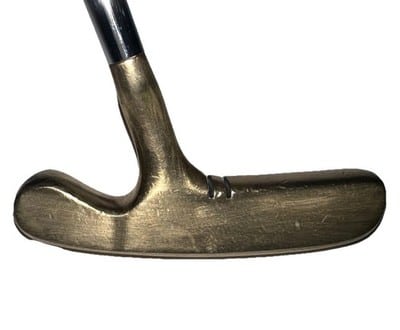
Acushnet Bullseye
The modern putting aisle is no longer a gallery of tools. It is a showroom of engineering fantasies less a sporting environment than a minor annex of NASA, had NASA been tasked with resolving the existential crisis of the six-foot putt. And yet, for all this technological pageantry, I find myself returning contentedly, almost stubbornly to something far simpler: a mid-1990s Laguna. A modest blade. Or, on occasion, a far less celebrated instrument: a $75 Carnahan Broadway – a piece of stainless steel with a milled face, a flare-tip hosel, and, most tellingly, a single white dot.
A Dot
After decades of innovation, we arrive back where we began. There is something both comic and inevitable in this. Golf technology has an uncanny habit of rediscovering its own past and presenting it as revelation. What is old becomes new; what is new reveals itself, upon inspection, to have been old all along.
I have, of course, flirted with modernity, I have rolled the mallet that swollen emblem of technological optimism. I have tested the Spider, the Odyssey Two-Ball, the Jailbird, the zero-torque apostles, and even the more philosophically inclined offerings that now gesture toward perception itself.
The result is always the same. Curiosity satisfied. Loyalty
restored. Not because the mallet fails it often performs admirably but because it demands something subtly absurd: that I become a technician of my own instinct, a middle manager of my own hands, supervising a process that was never meant to be supervised.
The Cult of Optimization
This is not merely an aesthetic shift. It is evidence of a deeper delusion: the belief that golf can be solved.
Enter the age of zero-torque putters, high-MOI mallets, and alignment systems so elaborate they resemble cockpit instrumentation. These devices arrive with the confidence of machines that believe they are correcting human error rather than participating in it. And here, the satire scarcely requires embellishment.
The Spider presents itself like a mechanical arachnid tasked with stabilizing your incompetence. It sprawls across the green with the quiet authority of a surveillance apparatus, its geometry implying that your role is largely ceremonial. The state being the putter knows best.
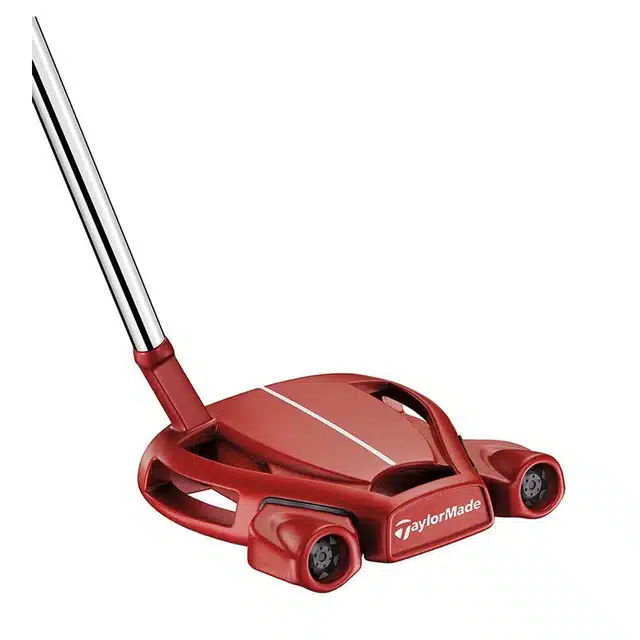
TaylorMade Spider
The Two-Ball, with its now-canonical pair of circles, operates on a different premise: that the golfer’s central deficiency is an inability to recognize shapes mastered in early childhood. It is ingenious and faintly insulting, a device that reassures by reducing the problem to something even you cannot misunderstand.
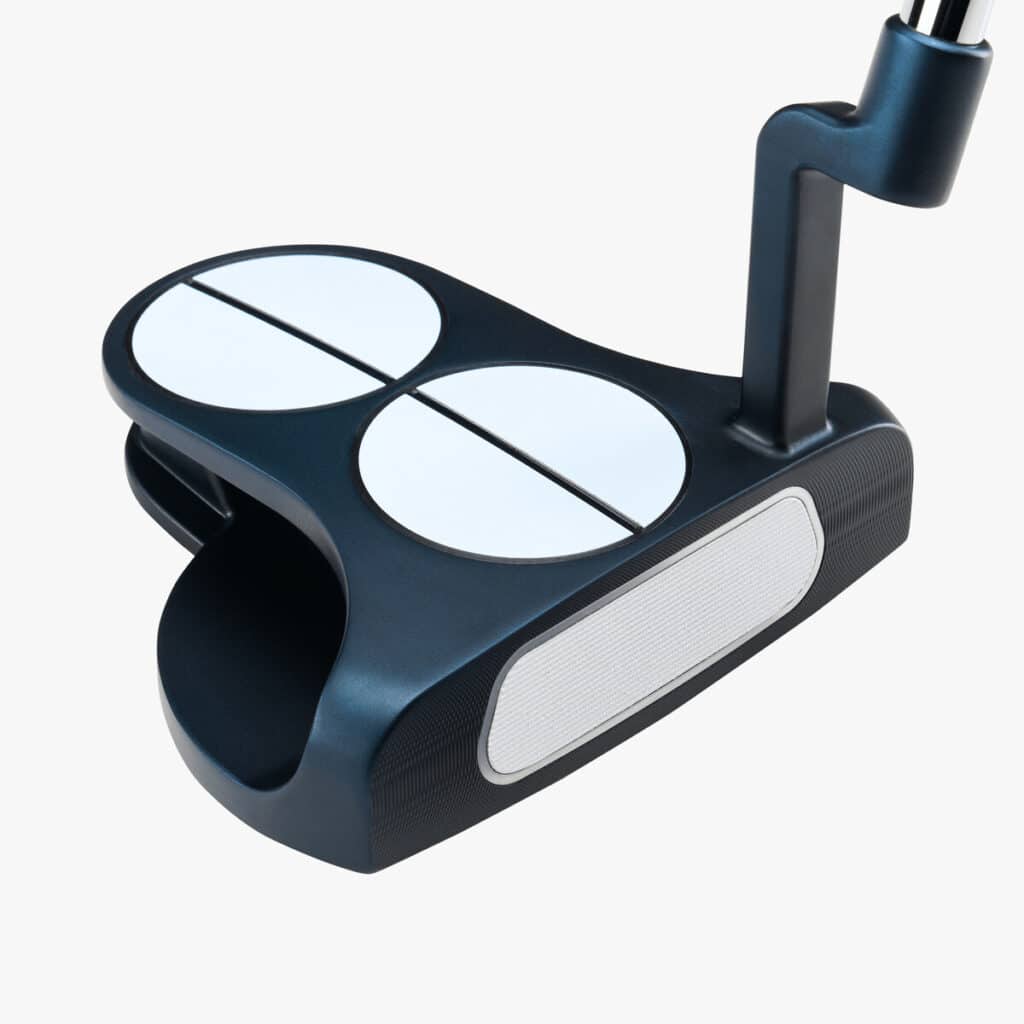
Odyssey Two Ball
The Oydyssey Jailbird, with its stark, penitentiary lines, appears less a putter than an interrogation instrument. One half expects it to demand an explanation after a missed putt, perhaps under a single swinging bulb. Its message is unmistakable: comply with the geometry, or answer for your deviation.
And then there are the zero-torque evangelists, whose implements often resemble prosthetic devices more than sporting equipment. Their doctrine is radical: eliminate rotation, eliminate variability, eliminate if one follows the logic to its natural conclusion the very conditions under which skill might express itself. This is putting as utopian engineering, the belief that if one removes enough variables, one may also remove the inconvenient human being attached to them.
We are told these devices reduce torque, stabilize the face, enhance alignment, and remove uncertainty. But one is left with a rather uncomfortable question: What, precisely, is being stabilized? The answer, when one dispenses with marketing euphemism, is not the putter face. It is the golfer’s anxiety.
The Tyranny of Aim
Thus, we arrive at the central dogma of modern putting: the tyranny of aim. There exists a near-theological belief that if alignment can be perfected, execution will obediently follow. This is, at best, a half-truth elevated to doctrine. Because the problem is not that golfers cannot aim. The problem is that they
never stop trying to aim.
Observe the ritual. The player stands behind the ball, constructs a line, inspects it, re-inspects it, approaches, retreats, adjusts by degrees too small to matter, and begins again. The eyes move incessantly ball, hole, face, line gathering information not for use, but for reassurance. And now, in the modern era, this ritual has acquired the trappings of scientific legitimacy. The golfer, armed with AimPoint, Tour Read, EGOS, and StrackaLine maps, begins to resemble not an athlete, but a junior research fellow attempting to reverse-engineer a hillside.
He paces. He calibrates. He assigns numbers to slopes that grass never agreed to possess. He holds up fingers like a man attempting to summon assistance from an unseen aircraft. One half expects him to request clearance from mission control before addressing the ball.
This, one suspects, was perfectly in character for Dave Pelz, who at least had the decency to be an actual rocket scientist before attempting to turn putting into one. But for the average golfer to approach a six-foot putt as though calibrating the trajectory of the James Webb Space Telescope is to commit a category error of almost heroic proportions.
Each glance is not observation. It is negotiation. And negotiation, in matters requiring commitment, is invariably fatal.
The Managed Stroke
From this condition emerges the managed stroke. The golfer, having failed to arrive at a settled visual decision, attempts to compensate during motion. The hands intervene. The face is guided, coaxed, subtly manipulated. The stroke becomes an exercise in real-time correction. What results is not a stroke. It is a correction masquerading as one.
Misses follow not because the mechanics are deficient, but because the intention is divided. And yet, the diagnosis remains stubbornly unchanged: “You need better alignment.” So, another putter is purchased. Another system adopted. Another illusion reinforced each acquisition offering not improvement, but a brief and expensive reprieve from doubt.
The Industry of Clarity
The marketplace, ever attentive to confusion, has responded with enthusiasm. Alignment systems have multiplied like theological sects arguing over the same absent deity. Lines have proliferated. Contrasts have intensified. Geometries have expanded into something approaching visual bureaucracy. But what is being offered is not clarity. It is more information. More to check. More to compare. More to doubt.
The eye is no longer invited to settle; it is encouraged to roam as though the solution to indecision were simply to provide more decisions. And so, the act of putting once a simple negotiation between perception and motion becomes an exercise in visual accounting. This is not refinement. It is escalation.
Engineering Without a Problem
We are now engaged in a peculiar exercise: applying increasingly sophisticated engineering to a motion that scarcely requires it. Moment of inertia has become the dominant article of faith, as though the success of a short putt depended upon resisting orbital forces rather than resisting the urge to interfere with oneself. But inertia is not the problem. Mental inertia is. The golfer, trapped in analysis, cannot transition from seeing to doing. And so, the engineering proliferates not because it is needed, but because it is comforting.
The Ideologies of Putting
It is no longer sufficient to say that golfers choose putters. They subscribe to them. They adopt their premises. They defend them. They evangelize them with the zeal of minor theologians. The Spider offers technocratic authoritarianism. The Two-Ball, populist reassurance. The Jailbird, punitive clarity. The zero-torque movement, utopian sterilization. AimPoint and its cousins offer something subtler: the illusion that uncertainty can be quantified, that doubt can be translated into numbers and therefore neutralized.
Each promises salvation. Each, in its own way, diminishes the very thing it seeks to improve.
A Curious Exception: When Design Points Inward
And yet, it would be intellectually lazy to dismiss all modern design as mere technological vanity. Occasionally almost accidentally the industry gestures toward something more interesting.
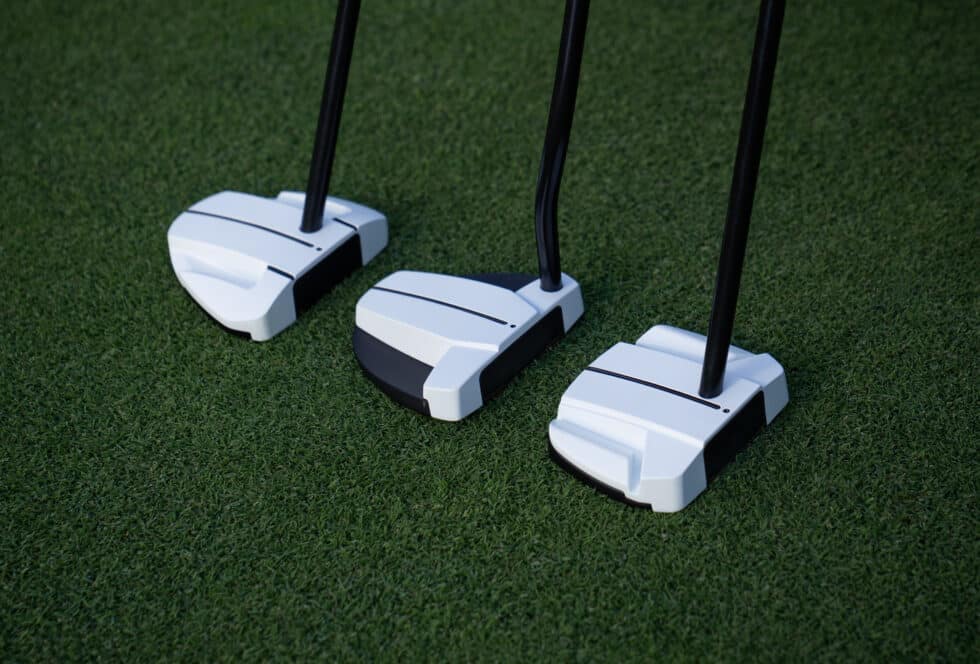
Ping Scottsdale TEC
The new PING Scottsdale TEC line is one such gesture. It does
not merely attempt to help you aim. It attempts however imperfectly to organize how you look. At the center of its design is a concept borrowed from sports vision research the so-called Quiet Eye manifested in a central dot, simplified contrast, and an onset hosel that clears the visual field. These are not, in principle, additions designed to give you more to process. They are attempts to give you less. After decades spent adding lines, tracks, rails, and geometric hieroglyphics, the industry’s latest innovation is, quite literally, a dot.
One cannot help but admire the irony.
A Different Proposition: The Gaze
This invites a more interesting question. What if the issue in putting is not aim, but attention? What if the problem is not where the putter points, but where the eyes reside? To aim is to search. To organize the gaze is to settle. One is restless. The other is resolved.
The End of Scanning
When aiming, the eyes behave like restless auditors. They move constantly ball, hole, line, face seeking certainty through repetition. This is not focus. It is agitation masquerading as diligence. But when the gaze is organized, something fundamental changes. A single point is selected a dimple, a logo, a dot and the eyes stop moving.
They rest. And in that stillness, the entire system reorganizes itself.
The Quiet Eye
Sports science, in one of its rarer moments of relevance, has identified this phenomenon as the Quiet Eye. Skilled performers look less. They look longer. And in that stability, something critical occurs. The brain ceases its recalculations. The body ceases its negotiations. The motion begins to organize itself.
The Stroke as Response
Under these conditions, the putting stroke ceases to be managed. It becomes a response. There is no attempt to guide the putter through impact. There is only a commitment from which motion arises. Not mysticism. Just the absence of interference.
The Misunderstood Dot
Consider the humble dot. In one context, it is merely another alignment aid another participant in the endless cycle of checking and correction. In another, it is something far more interesting: An endpoint. A place where the eyes land and stay. Same object. Opposite function. One perpetuates doubt. The other ends it.
Conclusion: Against the Tyranny of Aim
It is always tempting to believe that the solution lies outside oneself. A new putter. A new alignment system. A new promise of mechanical certainty. A new methodology for converting uncertainty into numbers and calling the result knowledge. But the deeper problem is not technological. It is perceptual. Golf has not been improved by turning putting into engineering. It has been complicated by it. Even when the industry, in a moment of near-accidental clarity, gestures toward somethingmore thoughtful as in designs that attempt to organize attention rather than merely refine alignment the essential truth remains unchanged: No device can commit for you.
The tyranny of aim persists not because it is imposed, but because it is embraced gladly, anxiously, repeatedly. Withdraw that participation. Abandon the false comfort of calculation at the moment it becomes interference. Quiet the eyes. Settle the gaze. And allow the stroke to be what it always was beneath the noise: A simple act of commitment, executed in motion.
Everything else is commentary.
Feature Photo: Getty Images