

Part IV of Brian Soomer’s series on Harbour Town Golf Links
https://spikeongolfandtravel.com/harbour-town-a-course-that-invites-rather-than-dictates/
https://spikeongolfandtravel.com/harbour-town-4/
https://spikeongolfandtravel.com/creating-golf-on-difficult-land/
By Brian Sommer
Harbour Town Golf Links on Hilton Head, S.C., did not enjoy the luxury of a cautious opening. While construction was still underway, the PGA Tour accepted developer Charles Fraser’s proposal to stage a tournament at the course over Thanksgiving weekend in 1969. The inaugural Heritage Golf Classic began on Nov. 27. Many players were startled. Tour golf in the late 1960s generally offered wider corridors and larger targets. Harbour Town gave them narrow and curving fairways, unusually small greens, overhanging branches, pot bunkers, lagoons, sandy hazards, and timber walls.
Some players complained- as they do today. During those first two rounds, the field produced 39 scores of 80 or higher. The reaction was instructive. When a golf course challenges the assumptions under which players normally operate, the first impulse is often to accuse the course of unfairness. The same reflex appears in coaching, education, leadership, and politics. An unfamiliar demand is treated as defective because it refuses to fit the accepted model. But unfamiliar and unfair are not synonyms. Harbour Town was not asking players to accept nonsense. It was asking them to notice more.
Arnold Palmer supplied the endorsement Sea Pines Resort Fraser and designer Pete Dye required. He finished at one under par, the only player below par for the week, and won by three strokes. His victory prevented Harbour Town from being dismissed as an eccentric experiment. The course became a national subject of fascination. The Heritage became an annual fixture and eventually evolved into the RBC Heritage. Its champions have included Jack Nicklaus, Johnny Miller, Tom Watson, Hale Irwin, Greg Norman, Payne Stewart, Nick Price, Davis Love III, Matt Fitzpatrick, Jordan Spieth, and Scottie Scheffler.
Nicklaus won in 1975, earning a victory on the course that helped launch his architectural career. Davis Love III, who renoavted the course in 2025, won five times, becoming the tournament’s most prolific champion. Decades later, he would return to help guide the restoration of the course that had rewarded his game so often. The tournament brought national recognition to Sea Pines and helped establish Hilton Head Island as a major golf destination. It also established Dye as a force in American architecture.
The Strategy of Small Decisions
Harbour Town is often called a course for accurate players. This is true in the way that saying a great novel contains words is true. It identifies a feature while missing the achievement. Harbour Town is not merely concerned with hitting narrow targets. It is concerned with which part of the target the golfer chooses and how that position alters the next shot. The course is built around connected decisions. On many holes, one side of the fairway offers a clearer view, a better angle, or access to the long axis of the green. Reaching that position may require challenging a bunker, tree line, lagoon, or uncomfortable visual line. The conservative route usually remains available. But safety is not free. It may leave an approach across a hazard, beneath a branch, or into the shallowest part of the green. Greater risk from the tee can create greater opportunity on the approach. The course does not insist that the golfer take that risk. It permits the golfer to choose. This is the architectural preservation of sovereignty. The course supplies the circumstances. The golfer remains responsible for the response.
Its trees make these relationships unusually precise. Trunks and canopies influence direction, launch, curvature, and height. A player on the wrong side of a fairway may need to keep the next shot beneath branches, bend it around a corner, or surrender an aggressive line to the flag.
The greens intensify the demand. They are small, subtly contoured, and frequently angled away from the line of play. Bunkers and falloffs punish different misses in different ways. A minor error in position may create a disproportionately difficult recovery.
This is why Harbour Town has survived advances in equipment more successfully than many courses of its age. Distance matters. It simply does not settle the argument. A 320-yard drive on the wrong side may be less useful than a shorter drive beneath the correct opening.
As late as 1995, Harbour Town measured only 6,657 yards and was the shortest regular venue on the PGA Tour. It was later stretched to approximately 7,200 yards, but length remains a supporting defense rather than its governing idea. That distinction matters in a game increasingly seduced by optimization. Modern golf treats more distance, more speed, more forgiveness, more data, and more certainty as self-evident goods. They are not. Every supposed improvement must answer a prior question: What is being improved? Does it help the golfer perceive and respond more intelligently? Or does it merely produce a more impressive number, a more elaborate explanation, or a more comforting illusion of control?
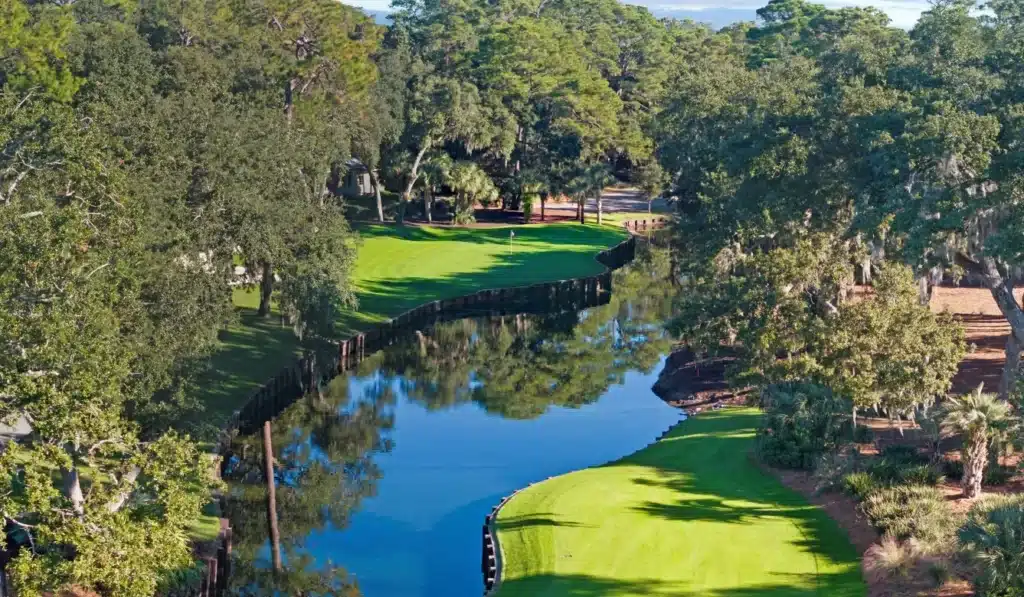
The 14rh hole at Harbour Town Golf Links (The Sea Pines Resort)
Technology, equipment, and coaching can all be useful. The problem begins when support becomes authority. The golfer is then asked to trust the model more than the shot, the measurement more than the experience, and the theory more than the ball.
Harbour Town never makes this demand. It can be known without being exhausted. Repeated play reveals preferred positions, but wind, firmness, tee location, hole location, and the golfer’s own capacities continually revise their value. The course remembers its identity without repeating itself.
The Holes That Define the Experience
One of Harbour Town’s greatest virtues is that its holes possess individual identities. This should not be controversial. Yet anyone who has played enough golf in South Florida knows that distinctiveness cannot be assumed. Too much of the region’s golf is routed through housing developments in a style that might charitably be called repetitive and more honestly called condo golf. The pattern is familiar. A flat par four of roughly 380 to 420 yards. A fairway bunker on one side. Water on the other. Minimal rough. A green with little visual distinction. Then the same arrangement is warmed over and served again. Harbour Town offers the opposite. Each hole looks and plays like a particular place.
Harbour Town asks the golfer to shape shots, alter trajectories, and respond to visual and aerial constraints. It is not one of those modern courses on which the governing tactic is to hit driver as hard as possible and negotiate the details later.
The par threes are particularly distinctive.
The fourth hole measures roughly 194 yards from the back tee, with water to the left and behind the green, a bunker at the rear, and a bailout area to the right. The trees create an intimate frame around a demanding target. The seventh can stretch to approximately 216 yards. Its narrow green is enclosed by large trees on both sides, with a bunker wrapping across the front. Golfers often speak of hitting out of a chute. The seventh asks for a shot into one.
The 14th presents a related problem in reverse. At approximately 188 yards, the water sits to the right and bunkers to the left. Again, the putting surface is narrow and the margin for indifference is small.
The 17th is where the wind from Calibogue Sound begins to exert itself fully. At roughly 198 yards, it often plays into the prevailing wind, with marsh and bunker left and an exposed green ahead. During my most recent round, I played the four par threes in even par. I had birdie opportunities at both the 14th and 17th but failed to convert them. The score matters less here than the variety of questions that produced it.
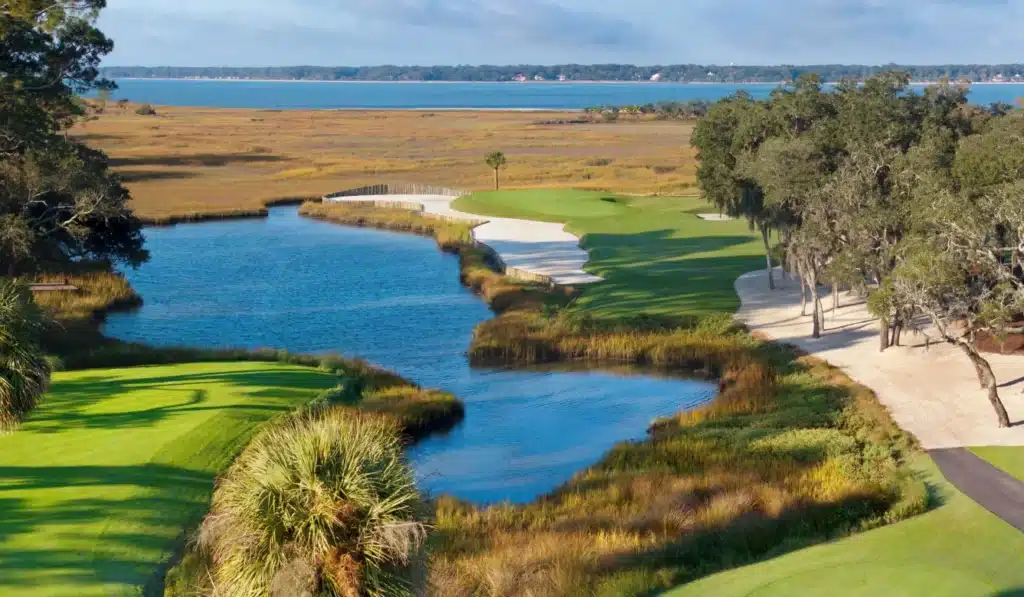
The 17th golf at Harbour Town Golf Links (The Sea Pikes Resort)
he par-five fifth remains one of my favorite holes on the course. Its difficulty increases as the golfer moves toward the green. The fairway turns through the trees, and the combination of sand, position, and the influential live oak makes the final approach more demanding than the modest yardage suggests. The restoration altered the hole noticeably. The green complex was lowered and reshaped, and the fairway now runs continuously through an area previously interrupted by a cart path.
From the tee, I hit a high draw and finished near the middle of the fairway, in an area close to where the cart path had previously crossed. From there, I had roughly 240 yards remaining. The hole is not exceptionally long. It does not need to be. Its intelligence lies in the sequence. The golfer must understand where the second shot should finish before deciding how aggressively to play the first. This is not obedience to a predetermined plan. It is attention to relationships.
The par-four 9th is another example of Harbour Town creating interest without requiring excessive length. The hole runs beside the driving range and measures only 326 yards from the tournament tees. By contemporary professional standards, it is scarcely a full par four. Many players in the Heritage field can reach the green with a driver, mini driver, or fairway wood.
I do not possess the speed of Ludvig Åberg, whom I once watched fly the green with a driver, nor that of Scottie Scheffler, who can routinely send a 3-wood into the bunker guarding its front edge.
That hardly makes the hole irrelevant. It makes the decision more interesting. The green, like so many at Harbour Town, sits at an angle. It is also shaped rather memorably like a heart, with a bunker behind it ready to collect any shot struck with more enthusiasm than judgment. From the tee, the golfer looks toward the imposing multi-story clubhouse built several years ago. On this occasion, our forecaddie offered a wonderfully specific aiming point: the large clock facing the course. I sent a strong drive down the left side of the fairway, and the ball stopped only a few feet short of the greenside bunker. From there, I pitched to tap-in distance before moving to the 10th.
The hole lasted only three strokes, but it required more than two swings. It required a choice from the tee, an appreciation of the green’s angle, and enough restraint around the target not to turn opportunity into trouble. That is Harbour Town in miniature.
The 12th is another favorite. It asks for a strong left-to-right tee shot and becomes especially demanding when the flag occupies the back-left shelf. The approach and green are beautifully framed, and the entire hole possesses an aesthetic coherence that is difficult to reduce to a yardage book. Its strategy changes with the wind, lie, and flag. There is no permanent solution called “how to play the 12th.” There is only today’s version of the hole. This wind. This flag. This lie. This club. This golfer. This moment. Experience remains useful. Strategy remains useful. Memory remains useful. But only if they remain accountable to reality rather than replacing it.
The par-four 13th is one of Harbour Town’s defining architectural statements.
Its fairway narrows the farther the golfer drives, forcing a choice between a shorter approach and a smaller landing area. The bunker, railroad-tie bulkhead, and angled green appear severe. Yet its difficulty does not reside in appearance alone. Its sophistication lies in the relationship among the narrowing fairway, the approach angle, the bunker, the overhanging trees, and the green. What appears dangerous may offer the best route. What appears safe may leave the hardest second shot. On my recent round, I drove the ball well down the left side and carried the fairway bunker. Despite finding the short grass, I still faced a large draw around a tree branch. I managed to send the ball up and over, but it failed to hold the green, leaving a manageable chip from the runoff behind it. The episode expressed the hole perfectly. The fairway had been found. The problem had not been solved.
Then comes the 18th. After seventeen holes framed mainly by trees, the golfer emerges beside Calibogue Sound and faces a fairway between 80 and 90 yards wide. The width is deceptive. Wind, water, approach angle, subtle mounding, and the small green continue to make position consequential. A drive safely to the right may leave an awkward angle. A ball challenged toward the water may produce a clearer approach, but at an obvious cost. During one round, I faced 178 yards to the green and struck a 6-iron to four feet. The memory remains special, but not because a 6-iron from 178 yards represents the correct solution.
There is no such solution. The club was correct because the shot emerged from the conditions of that moment. The wind. The lie. The target. The flight required. The golfer present to see it. The intelligence belonged not to a formula, but to the golfer in relationship with the shot.
Harbour Town will always be associated with its lighthouse, the Heritage tartan, Arnold Palmer, and more than five decades of tournament history. Its deeper legacy is architectural. It changed Pete Dye’s career. It helped redirect American golf design away from the assumption that championship golf required maximum scale. It showed that flat land could produce fascinating golf. It showed that trees could create strategy rather than merely decorate the landscape. It showed that a short par four could demand more thought than a long one. It showed that a conservative choice need not be punished immediately if it could create a harder problem later. Most importantly, it demonstrated that difficulty and interest are not the same thing.
A course can be made difficult through length, rough, forced carries, water, and narrowness. To remain interesting for decades, it must present choices whose consequences change with wind, ability, intention, firmness, and flag position. That is why Harbour Town still works. It is also why I do not tire of playing it. Its atmosphere is relaxed, but its questions are exact. Its corridors are compact, but its tee shots are inviting. Its landscape is consistent, but its holes are distinct. It does not attempt to overpower the golfer with grandeur. It does not reduce the game to execution. It does not provide a system for escaping uncertainty. It gives the golfer circumstances and leaves him responsible for the response. That is one reason I trust it.
Each shot returns the golfer to reality, where beliefs, explanations, credentials, hopes, and wishes carry no authority. That is Harbour Town’s enduring achievement.
Feature Photo: Fifth Hole at Harbour Town Golf Links (The Sea Pines Resort)