
Part III of Brian Soomer’s Four-Part Series: Harbour Town Golf Links: Its History, Restoration, and Enduring Appeal
https://spikeongolfandtravel.com/harbour-town-a-course-that-invites-rather-than-dictates/https://spikeongolfandtravel.com/harbour-town-4/
By Brian Sommer
The Harbour Town property at The Sea Pines Resort on Hilton Head, S.C., did not offer the obvious ingredients of greatness. It was low, wet, heavily wooded, and almost completely flat. Accounts of its construction suggest that the site contained only about four feet of natural elevation change. Drainage canals had to be cut. Water had to be consolidated into lagoons. Considerable technical intervention was necessary. Yet Dye wanted the finished course to remain low-profile and connected to the land. This ran against the dominant fashion in American championship golf.
Robert Trent Jones Sr., the period’s most powerful architectural figure, had become known for long courses, elevated tees and greens, expansive bunkering, and clearly visible hazards. His courses projected importance through scale. Dye moved in almost the opposite direction at Harbour Town. The tees were small. The greens were tiny. The fairways curved rather than turning through crude doglegs. Instead of elevating the golfer above the problem and displaying the whole thing in advance, Dye kept the player close to the ground. He demanded interpretation of partial views, narrow windows, overhanging branches, and uncertain angles.
This is one reason my admiration for Dye fits so naturally beside my admiration for Donald Ross. I have played Ross courses at Pinehurst No. 2, Seminole, the Country Club of Asheville, and Grove Park Inn. Ross often asks the same essential questions in a quieter vocabulary. His contours, slopes, green complexes, and approach angles make position meaningful without always announcing the demand. Dye is more provocative. Ross is more understated. But both respect the intelligence of the golfer. Neither man’s best work can be reduced to a formula. Neither provides one answer that remains correct in every condition. Wind, firmness, flag position, ability, intention, and executioncontinually revise the problem. That is reality. Mastery is not seeing less because one has seen the hole before. Mastery is seeing more because one has learned that reality does not repeat itself. Only our descriptions do.
At Harbour Town, immacutely renovated in 2025 by Davis Love III – the mature live oaks and pines were retained not merely as scenery but as strategic actors. A golfer could find the fairway and still be blocked from the direct route to the flag. Position within the short grass could matter as much as whether the short grass was found at all. Dye also used contrasting turf, sand, lagoons, timber edges, waste areas, and crushed shell to define the nearly level land. His most dramatic decision came near the finish. Earlier routing concepts had kept the closing holes inland. Dye turned the course toward Calibogue Sound. Material dredged from the harbor helped form the land for the 18th fairway.
The decision created one of golf’s most famous finishes. It also demonstrated one of Dye’s defining gifts. At later courses, he would manufacture enormous landscapes. At Harbour Town, he manufactured complexity without making the landscape appear manufactured.
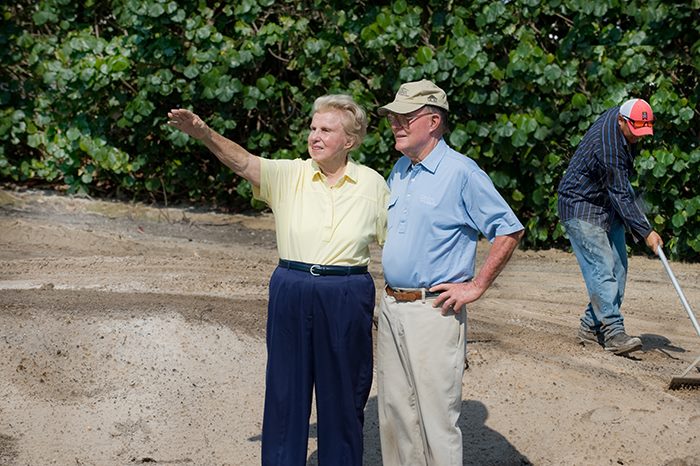
Photo: Alice and Pete Dye at Harbour Town Golf Links (The Sea Pines Resort)