
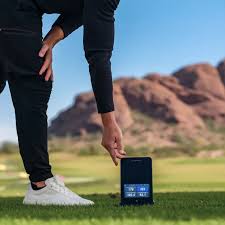
Part I of Brian Sommer’s four-part look into the Priesthood of Numbers
There is a peculiar superstition spreading through modern golf. Like all successful superstitions, it disguises itself as progress. It does not concern shallowing the club, wrist conditions, pressure traces, or ground reaction forces. Those are merely its vocabulary. The superstition itself runs much deeper. It is the belief that measuring more necessarily means understanding more.
Modern golf has quietly accepted this proposition as self-evident. Challenge it and one is met with the same polite bewilderment reserved for those who question whether the Earth revolves around the Sun. Of course, more information is better. Of course, more numbers produce better golfers. Of course, every improvement begins with another metric.
Does it?
The question is worth asking precisely because almost nobody asks it.
I should confess my own guilt before proceeding. I have been playing with launch monitor technology for years. This is not the complaint of someone who wandered onto a driving range, saw a glowing screen, and declared civilization finished. Quite the opposite.
I have owned it. Used it. Compared it. Experimented with it. Questioned it. Enjoyed it. And continue to do so. Technology in golf is fascinating. It is also one of the finest examples I know of confusing measurement with understanding. There is a difference. An enormous one.
Rocket Science Comes to the Driving Range
Launch monitors are often presented as though they represent some revolutionary moment in golf history. They do not. The technology itself is hardly new.
Long before golfers began debating attack angle over coffee, sophisticated radar systems were tracking rockets leaving places like Kennedy Space Center and Johnson Space Center. Doppler radar, optical tracking, ballistic prediction these are not inventions born on the practice tee. They belong to engineering disciplines where extraordinary precision determines whether something reaches orbit.
Golf simply inherited them.
What was once the province of aerospace engineers has become commonplace on the practice range at a PGA Tour event.
Walk down almost any Tour practice tee today and you will encounter a curious spectacle. TrackMan. GCQuad. Occasionally both. Players quite literally double-fisting launch monitors, as though one oracle might accidentally contradict the other.
The technology is extraordinary. The behavior surrounding it is rather more interesting. Watch carefully. A player strikes a beautifully compressed seven iron. The golf ball climbs effortlessly into
the sky. But before the shot has reached its apex before it has even begun descending toward its target the golfer’s eyes have already fallen.
Not toward the flag. Toward the screen. The ball has scarcely begun its journey before another ritual begins. Ball speed. Clubhead speed. Spin. Carry. Launch. Peak height. Landing angle. Smash factor. The numbers are consumed with the urgency of someone checking financial markets during an economic collapse.
One begins to wonder whether golfers still enjoy watching golf balls fly. Or whether the flight itself has become merely another confirmation of what the machine has already declared.
My First Encounter with the Digital Oracle
My own first experience with portable launch monitor technology was not TrackMan. Nor GCQuad. It was a wonderfully peculiar little device called the Voice Caddie.
Those of a certain age will remember the Palm Pilot. For those too young to have suffered through the early years of personal digital assistants, imagine an oversized iPhone wrapped in grey plastic with all the aesthetic charm of office stationery.
That was essentially the Voice Caddie.
It possessed none of today’s polished graphics. No animated trajectories. No immersive simulator. No dazzling interface. No artificial intelligence. It simply produced numbers. Then it spoke them aloud. Ironically, I remember its voice recognition being clearer and more reliable than many of today’s supposedly intelligent voice assistants. Progress, it appears, is not always cumulative. I found it fascinating. Not because I imagined it possessed hidden truths about golf. Because it was interesting. Curiosity and certainty are frequently mistaken for one another. They are not remotely the same thing.
Bigger Machines, Bigger Promises
Over the years I have been fortunate enough to spend considerable time with TrackMan, GCQuad, Bushnell Launch Pro, and other systems. They are genuinely impressive.
TrackMan remains one of the great engineering achievements in golf, using Doppler radar to observe the golf ball throughout much of its flight. GCQuad approaches the same problem differently, employing four ultra-high-speed cameras to capture the collision between club and golf ball with astonishing precision. Bushnell’s Launch Pro, Foresight’s systems, Garmin’s increasingly capable offerings, Rapsodo’s portable devices each represents an elegant engineering solution to the remarkably difficult problem of measuring a golf shot.
Then there is the Shot Scope LM1. In many respects, it is the most interesting of the group. Not because it is the most sophisticated. It isn’t. Not because it measures the most variables. It doesn’t. It is interesting because of what it attempts to be. The LM1 is refreshingly modest. It does not pretend to replace a professional fitting studio. It does not overwhelm the golfer with dozens of variables.
Instead, it promises something wonderfully simple.
A Surprisingly Capable Little Machine
The Shot Scope LM1 is, by almost any reasonable standard, an impressive little launch monitor. For a device roughly the size of a paperback novel and costing less than many premium drivers, it performs remarkably well. Independent testing has shown carry distances surprisingly close to launch monitors costing many thousands of dollars more.
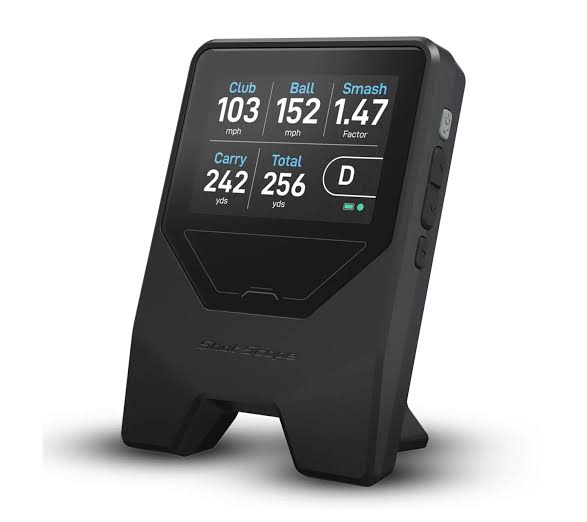
Shot Scope LM1 (Shot Scope)
Albeit, surprisingly close on some shots.
There were a number of shots that I had the other day on the driving range that were landing in the 160–170-yard range, but the LM1 was consistently reading 180-plus. Now, let us be fair. I was gauging my yardages from the sandwich board on the range, with the various colored flags representing different distances. For argument’s sake, let us assume those distances were inaccurate. Perhaps the LM1 was actually closer to the truth. Since I was not overly ambitious enough to pull out my Nikon rangefinder and verify each target, I can only tentatively conclude that the LM1 consistently reported longer carry distances than appeared to be showing up on the range.
That is hardly a scientific conclusion. It is simply an honest one. The LM1 is lightweight. Portable. Subscription-free. Simple to operate. Its display is clean and uncluttered. The numbers are large enough to read without squinting, and the radar housing itself looks reassuringly substantial as though engineering confidence can somehow be communicated through industrial design.
To ensure accurate performance, Shot Scope recommends placing the LM1 approximately four to five feet behind the golf ball, aligned with the intended target line, with the face of the unit pointing directly downrange. Setup requires only moments. Then one simply begins hitting golf balls. The LM1 considers its key statistics to include clubhead speed, ball speed, smash factor, carry distance and total distance.
Move through the entire golf bag from driver to lob wedge and, as the industry likes to say, one can become dialed in.
Dialed in. It is one of those wonderfully confident phrases that everyone repeats and almost nobody examines. Dialed in to what, precisely? A launch condition? A carry distance? A statistical average? An optimization model? Or perhaps the golf course itself?
The distinction matters. Because those are not remotely the same thing. There is also, naturally, a speed training mode. Modern golf appears increasingly convinced that happiness lies just beyond another two miles per hour of clubhead speed. The LM1 accommodates that ambition quite happily. It can be used on the practice range. It can be used on the golf course, although I remain unconvinced how often most recreational golfers will actually do so. Tour professionals, perhaps. The average Saturday golfer? I am rather less certain.
And, of course, there is an accompanying app. There is always an accompanying app. No modern piece of technology appears complete until it possesses a digital companion capable of archiving
years of data for later inspection. The application dutifully stores every session, records historical trends, and presents them back to the golfer with admirable efficiency.
One imagines future archaeologists concluding that twenty-first-century civilization spent equal amounts of time photographing its lunches and cataloguing seven-iron carry distances. Whether this represents progress remains delightfully open to debate.
Shot Scope’s marketing also promises something rather more ambitious. It claims the LM1 will transform “hitting balls into data-driven practice.” That sentence stopped me. Not because it is unreasonable. Because it reveals something far more profound than perhaps its authors intended. Why should practice become data-driven? Who decided that was the objective? Practice, at least as I have come to understand it, has never primarily been about accumulating information.
It has been about developing relationship. Relationship with the club. Relationship with the golf ball. Relationship with the target. Relationship with uncertainty. Relationship with changing conditions. Most importantly, relationship with one’s own awareness. Information can certainly support that process. It cannot replace it.
That distinction, I suspect, is where modern golf increasingly loses its footing. Another curious and perhaps not so curious observation occurred almost immediately. After each shot, I found myself looking back toward the little oracle sitting on the ground. Not to observe the golf ball. Not to remain with the shot. But to validate. To assess. To measure. Ironically, it pulled me away from each shot more quickly than I realized. I even caught myself hitting a handful of warm-up shots simply to gauge the system, rather than remaining with what the shot itself was asking for.
I became less available. Not because the LM1 demanded it. Because I quietly surrendered my attention. That, perhaps, is one of the more interesting unintended consequences of modern launch monitor technology. The machine had done absolutely nothing wrong. The golfer had.
Feature Photo Credit: Austad’s Golf