
By Brian Sommer
There is a peculiar modern superstition in golf equipment design – polished, efficient, technologically fluent, and utterly convinced of its own benevolence. It is the belief that if one refines geometry sufficiently, redistributes mass with adequate precision, and surrounds metallurgy with enough language about innovation, one will eventually arrive at something approaching certainty in putting.
Not competence. Not touch. Certainty. In this vision, the putter ceases to be an instrument of judgment and becomes something closer to an oracle. And like most oracles, it is impressive, expensive, and faintly untrustworthy.
The modern mallet is perhaps the purest expression of this belief. Its promises are familiar and increasingly unquestioned: Higher MOI. Greater stability. Improved forgiveness. Reduced face rotation. Consistent energy transfer. Observe the language carefully. Very
little of it concerns perception. Almost none of it concerns awareness. Nearly all of it concerns insulation.
The golfer, we are told, should no longer experience the full consequences of inconsistency. Error should be softened. Variation should be distributed. Outcomes should remain emotionally tolerable. The modern mallet does not merely improve putting. It quietly proposes a new relationship to responsibility.
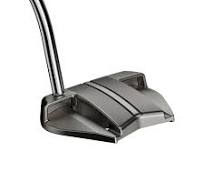
The Cobra MIM Stingray is a particularly useful specimen. To its credit, it is a very good object. Its rounded symmetry is deliberate and unusually elegant. Its weighting is purposeful. Its use of Metal Injection Molding in 304 stainless steel is thoughtful rather than decorative. The Pebax insert softens impact in a way many players, me included, find genuinely enjoyable.
This deserves acknowledgment. I had an excellent experience with the Stingray. The ball rolled evenly. Impact felt muted. The sound remained pleasantly restrained. Unlike many modern mallets which announce contact with the subtle acoustic qualities of industrial machinery the Stingray allows the strike to remain civilized.
This matters. I have long preferred softer, denser, quieter feedback. Yet enjoyment and agreement are not identical. Because the Stingray is not merely a putter. It is an argument.
Its central claim is straightforward: The golfer’s stroke should no longer bear the full burden of consequence. This philosophy only becomes visible when contrasted with what preceded it. There was a time dimly remembered now by golfers old enough to recall persimmon and emotional accountability when putting was understood differently.
The blade was not a mitigation device. It was anexposure device. It did not redistribute mass in your favor. It did not protect intention from execution. It simply asked: Did you strike the putt you believed you struck? And then answered. Immediately. Often rudely. The blade did not flatter. But it revealed
Then came the mallet. And with it arrived a subtle philosophical shift disguised as engineering progress. Forgiveness ceased being metaphor and became specification. Stability became virtue. MOI became secular grace. Soon the market filled with increasingly sophisticated systems designed not merely to improve outcomes but to reduce the emotional cost of producing them.
The modern mallet movement did not ask: How can we improve awareness? It asked: How can we reduce punishment? These are not identical questions. The distinction matters. Golf has never been a neutral activity. Its entire structuredepends upon friction.
The friction between intention and outcome. The friction between perception and reality. The friction between what we imagined and what actually occurred. Remove all friction and one does not necessarily improve golf. One risk misunderstanding it.
This is where contemporary putter design becomes interesting. Because despite their aesthetic differences, many modern putters now participate in the same civilizational project. The modern high-MOI putter says, your face should rotate less. The square-to-square putter says, your release should become less relevant. The alignment-heavy putter says, your eyes should decide less. The AI-assisted putter quietly asks why leave uncertainty to human beings at all?
Different methods. Same proposition. Reduce interpretation. Increase predictability. Again, this sounds perfectly reasonable. Until one asks an impolite question.
If awareness becomes optional, what exactly is being learned?
This is where putting culture begins to resemble instruction culture. The golfer increasingly stands over the ball occupied not with rolling the putt but with producing good putting. Routine. Mechanics. Path. Control. Confidence. Process. One stops relating to the putt and starts relating to oneself putting.
One of my coaches once pointed toward something profoundly irritating and therefore probably true, the body organizes itself around a target. Which means the question may not be, how do I control the stroke? But can I see the putt clearly enough to allow movement?
This distinction becomes uncomfortable in a world increasingly organized around management. Because management feels responsible. Awareness feels uncertain. Yet
uncertainty may not be the enemy. Uninterpreted uncertainty is. There is a difference. A blade demands attention because consequence remains visible. A forgiving mallet may soften consequence so effectively that attention becomes less necessary.
This is not nostalgia. It is structure.
It is entirely possible for the modern mallet to lower scores while simultaneously reducing awareness. Those claims do not conflict. The golfer becomes more stable. Perhaps more repeatable. But possibly less perceptive. To be clear, this is not an indictment.
The Cobra Stingray succeeds beautifully at what it attempts. Its softness is real. Its stability is useful. Its forgiveness is genuine. Many golfers will putt better with it. That is not in dispute. The question is simply whether better putting and deeper urnderstanding are always the same hing.
History offers an interesting perspective. Modern mallets cannot really be understood without a quiet legal event. When the original patent surrounding the heel-toe weighting concepts popularized through the Ping Anser era expired, what disappeared was not merely exclusivity.
A philosophy became public. Perimeter weighting. Forgiveness. Stability. These ideas escaped ownership and became a language. The modern mallet is not an invention so much as an ongoing commentary on that language. Every manufacturer now competes not with patents but with consequences.
How much responsibility should remain? How much error should survive? How much discomfort should be permitted? And at what point does accommodation become concealment?
There remains, stubbornly, a counter-tradition. Players who choose blades and compact putters not because they dislike forgiveness, but because they value information. For them, feedback matters more than comfort. They prefer to know immediately when they have manipulated a putt rather than discover later that the geometry politely absorbed it.
This is not romanticism. It is epistemology. And perhaps that is the quiet question sitting beneath every modern putter release.
Not, does this improve performance? But what kind of golfer quietly emerges if it does? Because the danger is not that forgiveness exists. The danger is confusing softened consequence with understanding.
A putter should help. But eventually one must still putt. And there remains a meaningful difference between putting and trying to produce good putting.
Cobra MIM Stingray (Cobra Golf)