
By Brian Sommer
Professional golf has spent centuries polishing its image. Its competitors wear collared shirts. Spectators whisper. Hats are removed after the final putt. Broadcasters lower their voices as though the eighteenth green were a chapel rather than a sporting arena. The game cultivates an image of civility unlike any other major sport.
There is nothing wrong with civility. There is something deeply wrong with confusing civility with professionalism. Professionalism is not an appearance. It is not etiquette. It is not tradition. Professionalism is institutional competence. It is the confidence that every competitor enters the contest under the same conditions, governed by the same rules, administered in the same way, at the same time.
That is where golf increasingly appears uncertain. The irony is almost impossible to ignore. Th game has never possessed a more sophisticated rulebook. It has never possessed more cameras. More officials. More technology. More replay. More data. Yet it still struggles to answer one remarkably simple question.
When should a rule become real?
Not whether the rule exists. Not whether the player intended to violate it. Not whether the penalty is technically correct. When. Because timing is not a procedural detail. Timing is part of justice. And justice delayed is rarely justice improved.
Every Game Is a Constitution
People often speak about sporting rules as though they descended from nature itself. They did not. Sport is a voluntary agreement. Football decided a touchdown would be worth six points. Baseball decided three strikes would constitute an out. Basketball decided a free-throw line should exist 15 feet from the basket. Golf decided there would
be 18 holes. None of those decisions is inevitable. They are agreements. That means the rules of every sport function much like a constitution. Not because they are sacred. Because they establish the framework under which everyone agrees to compete.
The first written Rules of Golf, drafted in 1744 by the Gentlemen Golfers of Leith, consisted of just 13. Today, the Rules of Golf, their interpretations, committee procedures and clarifications occupy hundreds of pages. The rulebook has grown. The language has evolved. The R&A – ruler of the Open – and the USGA each deserve genuine credit for their 2019 modernization, simplifying wording and making the rules more accessible.
Language matters. Clear language produces clearer thinking. But a perfectly written constitution administered inconsistently remains an imperfect constitution. Rules do not derive legitimacy from how elegantly they are written. They derive legitimacy from how consistently and how promptly they are enforced.
Protecting the Field
Whenever controversy erupts, officials reach instinctively for one familiar phrase. “We have to protect the field.” Of course they do. Every competitor deserves protection from unfair advantage. Nobody serious disputes that. The interesting question begins immediately afterwards. Who protects the competitors from inconsistent administration? The purpose of rules is not merely to identify violations. It is to administer justice fairly. Those are different responsibilities.
Golf has never lacked accusations of cheating. Improved lies. Questionable drops. Incorrect scorecards. Grounded clubs. Dubious relief. Human beings have always been capable of testing boundaries.
Bryson DeChambeau did not invent that tendency. Nor did Tiger Woods. Nor Sergio García. Nor Dustin Johnson. Nor will the next controversial player. The question is not whether competitors occasionally violate rules. They always will. The question is whether the institution enforcing those rules inspires equal confidence. Institutions do not protect competition simply by announcing that they are impartial. They protect competition by demonstrating it. The purpose of rules is not merely to produce obedience. It is to produce legitimacy.
Bryson Isn’t the Story
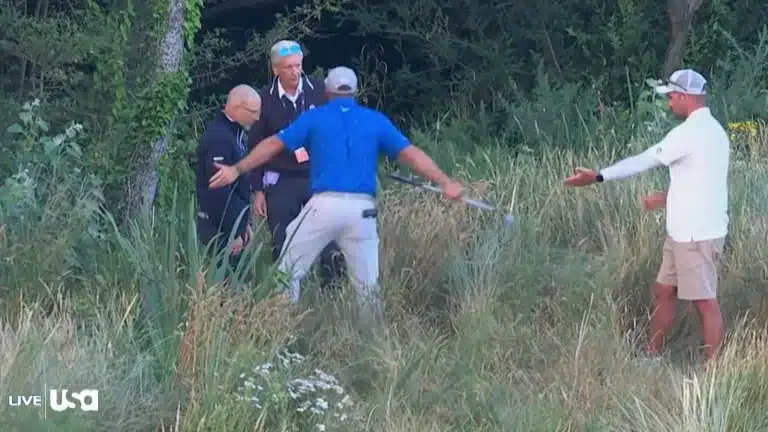
The recent controversy involving Bryson DeChambeau at the Open Championship has generated precisely the wrong debate. People ask whether he deserved the penalty. That is almost the least interesting question. Reports indicate that officials concluded he improved the conditions affecting his stroke by trampling long fescue before playing his shot. If Rule 8.1 was violated, then a penalty is entirely appropriate. Rules should be enforced. That is not controversial. Nor do I have any reason to believe Bryson deliberately attempted to cheat.
Intent, however, is largely irrelevant. Rules often concern outcomes rather than motives. The real issue begins after that. Not with Bryson – with the institution. In the second round of the Open, Bryson continued playing his round believing he stood at seven under par. His competitors believed he was seven under. The Open leaderboard displayed seven under. Strategic decisions were made under that shared understanding. Only afterwards did the institution announce that reality had changed. He was not seven under. He was five.
That distinction matters enormously. Not because Bryson lost two strokes. Because the competition itself unfolded under information that later proved false. Imagine he had been leading the championship. Imagine another player attacked a tucked flag on the closing holes because the
leaderboard showed Bryson at seven under. Imagine discovering half an hour later that Bryson had actually been five under all along.
The shots cannot be replayed. The strategic decisions cannot be recalled. The competition occurred under one reality. The ruling created another. Institutions lose credibility when they ask competitors to compete in one reality and judge them in another.
The Competition Didn’t Change. The Score Did.
This is where professional golf increasingly distinguishes itself and not in a flattering way. Football reviews before the next snap. Basketball reviews before the ball is inbounded. Tennis reviews before the next serve. Baseball reviews before the next pitch.
Competition pauses. Officials decide. Everyone proceeds under the same understanding. Golf too often does the opposite. Competition continues.
Players adapt. Strategies evolve. Leaderboards influence decisions. Then, after the fact, the score changes. The competition did not change. The paperwork did. That is an extraordinary way to administer a professional sport.
Who Actually Holds Authority?
The Bryson incident at the Open exposes another uncomfortable question. Who exactly possesses authority during a championship? The walking rules official? The chief referee? The committee? Video review? Television? Social media?
Can an official – at the Open or any major championship – assess a penalty immediately? Or must significant rulings migrate upward into committee deliberation worthy of another century? Professional golf sometimes gives the impression that authority itself remains provisional. Everything appears settled – until it isn’t. An institution should never leave competitors wondering who is actually making decisions. Authority delayed is authority diluted.
Dustin Johnson and the Cost of Ambiguity
If Bryson illustrates the problem of delayed enforcement, Dustin Johnson illustrates the problem of unclear reality. Standing on the seventy-second hole of the 2010 PGA Championship at Whistling Straits, Johnson held a one-shot lead. His drive finished in a sandy area trampled by spectators. To almost everyone watching that it looked like bare ground. It scarcely resembled a bunker. Johnson grounded his club. Only afterwards did officials inform him that local rules declared every sandy area on the property to be a bunker.
He received a two-stroke penalty. His bogey became a triple bogey. Instead of entering a playoff for the championship, he fell into a tie for fifth. Again, the issue is not whether the rule technically existed. It did. The issue is whether a competitor standing on the final hole of a major championship should reasonably be expected to distinguish a bunker from something that no longer visibly resembles one. Rules should clarify competition. Not create ambiguity.
Photo: USA Network