
By Brian Sommer
Golf has never suffered from a shortage of people willing to tell you where to put your hands. For more than a century, instructors have drawn lines across photographs, counted knuckles, inspected thumbs, debated Vs, prescribed pressure points and assured generations of golfers that the road to salvation begins somewhere between the index finger and the heel pad.
GripFix has managed to compress much of this accumulated wisdom into a small piece of molded plastic, and there is something rather admirable about that. No app is required. No Bluetooth connection. No launch monitor. No subscription. No phone balanced precariously against a range basket recording your wrists at 240 frames per second. You are not asked to discover that your lead wrist is 3.7 degrees outside some preferred window at P4. You simply slide the thing over your grip and put your hand where the mold tells you. Civilization survives.
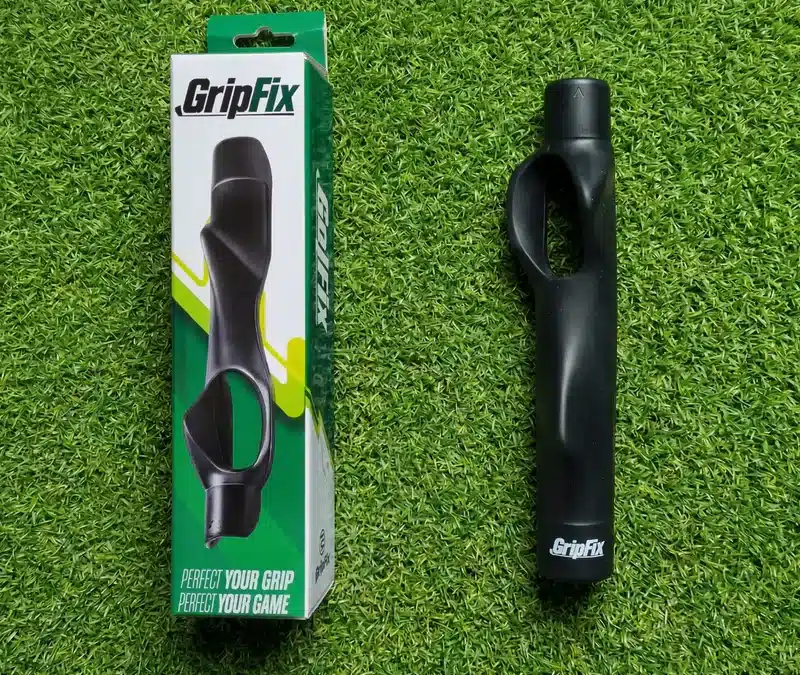
GripFix, is a small pre-molded training aid designed to attach to virtually any club in the bag, from wedge to driver. Its purpose is straightforward: place the lead hand into what the company regards as the correct neutral golf grip, allow the golfer to experience that position, and then repeat it.
I recently bought one and took it to the range. My reaction, both when I opened the package and after hitting balls with it, was fairly simple it was fine. That may sound like faint praise, but it isn’t meant that way. GripFix does what it says it does. It fits onto the club. It provides a very definite place for the lead hand. You can hit actual golf shots with it. Nothing about using it felt especially awkward or objectionable. But nothing about the experience struck me as revelatory either.
That is not an assertion that my normal grip is somehow “correct.” I have no interest in making that claim. It is simply what happened. I put the device on, hit balls, took it off, and hit more balls. The experience was not dramatically different. In some ways, that may be the most useful place from which to evaluate GripFix, because the product itself is perfectly reasonable. The more interesting question is whether the golfer needs it.
First Impressions
GolFix markets its materials and construction as more durable than inexpensive alternatives and says it can remain attached while hitting full shots. When mine arrived, the packaging and presentation were fairly ordinary. The product itself also felt like exactly what it is, a small, molded training aid. I wouldn’t make too much of that. Golf training aids do not need mahogany boxes and engraved certificates of authenticity. Their job is to be useful. Still, at roughly $35 for a single unit, I expected perhaps a little more substance in the presentation and in the feel of the product itself. Not dramatically more, just more.
GolFix does offer package pricing and discounts when several of its products are purchased together, and I can certainly imagine someone buying GripFix without feeling cheated by the transaction. The question for me is less whether the price is outrageous it isn’t and more whether the experience produced enough value to make the purchase particularly compelling. For some golfers, perhaps. For me, less so.
Its Best Feature Is That It Requires Almost No Explanation
Golf instruction has a remarkable ability to take things the human body can discover rather quickly and turn them into subjects resembling graduate seminars. GripFix does the opposite. There is almost nothing to understand. You align the device correctly, put your lead hand into it, grip the club, and hit a ball. This is its great virtue. The golfer doesn’t need to memorize the number of knuckles that should be visible. There is no need to inspect whether the V between the thumb and forefinger is pointing at the right shoulder, the chin, the collarbone or whatever destination is currently in favor. The mold simply puts your hand somewhere, and you feel it.
Give a golf club to someone who has never played before or someone who has played their entire life and ask that person to hold it. There is nothing especially intuitive about the resulting arrangement. The club is not a baseball bat, a tennis racket or a hammer. The hands occupy a peculiar relationship to the handle and to one another.
GripFix provides an immediate physical reference without requiring an instructional lecture. I like that. I also like that you can hit actual golf shots with it. This is not merely a device for standing in the living room rehearsing positions while your family begins quietly discussing your condition. You can put it on a seven-iron and hit balls, move it to a driver and hit balls, then take it off and hit some more. GolFix itself encourages golfers to alternate between using the trainer and removing it, presumably so that the sensation begins to transfer to an ordinary grip. That makes sense, and that is exactly what I did.
What surprised me was how little changed. With GripFix attached, my hand settled into the mold, and I hit balls without difficulty. The device felt a little small overall, but not to the point of making it unusable. It certainly gave me a defined reference for the lead hand. Then I removed it and hit balls normally. I did not experience some dramatic sensation of suddenly returning to a radically different grip, nor did the club suddenly feel foreign without the plastic there. The two experiences were remarkably similar.
Again, this proves absolutely nothing about whether my grip is technically correct. It merely tells me that, for me, GripFix did not expose some large discrepancy between the way I normally hold a club and the neutral position it was trying to produce. Someone else may have a completely different experience, and that is precisely the point.
The Problem With “Correct”
GolFix does not merely say that GripFix offers a neutral reference. It describes the position as correct, and there is a difference.
According to the company’s marketing, the device places the golfer’s lead hand into the correct neutral position, helps produce a square clubface and addresses causes of slicing and inconsistent ball striking. The company has also promoted the idea that the lead hand controls a very large percentage of clubface position.
There are several ideas bundled together there. Grip certainly matters. Changing the relationship of the hands to the club can change the clubface.
Golfers can discover this experientially without much difficulty. Take your normal grip, turn the lead hand dramatically stronger, and hit a ball. Now turn it dramatically weaker and hit another. Unless you possess compensatory talents unavailable to most of us, the shots will probably differ.
Research supports the broader point as well. Studies comparing stronger, neutral and weaker grips have found differences in clubface relationships, wrist movement, launch direction, accuracy and other variables. Excellent. Grip matters. But notice what has happened. We have established that grip position can change a golf shot. We have not established that one particular grip position is optimal for every golfer. Those are not the same claim.
This is a recurring habit in golf instruction. A relationship is discovered, then a preference, then a recommendation, and then, before anyone has quite noticed the transition, the recommendation has acquired the status of natural law. Neutral becomes correct. Different becomes wrong. Somewhere along the way someone manufactures an object to keep us all in compliance. GripFix itself needn’t carry all of that baggage. It is perfectly useful without it.
The Human Hand Has Not Been Standardized
Golfers are different. This observation is so obvious that it should not require saying, which is precisely why golf instruction so frequently forgets it. Hands vary in size. Fingers differ in length. Wrist mobility varies. Forearms rotate differently. Grip diameter changes. Golf swings differ. Release patterns differ. Clubface tendencies differ. Desired ball flights differ. Some players naturally deliver the face differently from others.
It would therefore be surprising if all of these variations culminated in one ideal molded hand position. This is also where my own experience with GripFix became relevant. Even though the device felt somewhat small. That doesn’t mean the product is poorly designed. It may fit another golfer beautifully. But the sensation reinforced the obvious limitation of any pre-molded training aid it has to be molded to something. It has to be molded to a general hand, an assumed hand, a representative hand, but not your hand and certainly not every hand.
This does not make neutral meaningless. Neutral is useful because it is a reference. So are strong and weak. They allow us to describe roughly how the hands sit on the club. But a reference point should not be mistaken for a commandment. A golfer may play excellent golf with a grip somewhat stronger than the position molded into GripFix. Another may function perfectly well with one slightly weaker. An experienced player may deliberately alter the grip depending upon the shot.
A golfer who doesn’t fit comfortably into GripFix has therefore not necessarily discovered a defect. He may simply have discovered that he is not shaped like GripFix. This should not be regarded as a moral failing.
The Better Use: Comparison
I think the most interesting way to use GripFix is not necessarily the way implied by its strongest marketing. Don’t use it as an answer. Use it as a reference. Put it on and hit ten balls. Notice the grip, the clubface, the contact and the flight. Then remove it and try to reproduce the same sensation. Now make the grip slightly stronger and hit some shots. Make it weaker and hit some more.
What changes? What doesn’t? Can you intentionally curve the ball? Can you sense what the face is doing? Does the GripFix position actually help you? Now the device becomes more interesting. It gives the golfer a very clear reference from which to explore. That is quite different from saying, “Here is the proper grip. Please memorize it.” One approach develops discrimination. The other develops compliance. Golf already supplies ample opportunities for compliance. What golfers need rather more of, in my view, is the ability to notice what happens when they change something. GripFix can help with that. The plastic itself does not have to know the answer. The golfer can find out.
“Feel, Not Instruction”
GolFix occasionally comes very close to making this argument itself. One of the company’s marketing phrases emphasizes feel rather than instruction. That is probably my favorite part of the idea, because there is something deeply sensible in it. A golfer does not necessarily need another paragraph explaining what a golf grip should feel like if he can simply experience one. Here. Try this. That may be enough. The trouble begins when the experience is immediately interpreted for him. This is correct. This squares the clubface. This solves the problem. This is where your hand belongs.
Now we have taken a potentially useful sensory experience and turned it back into instruction. Why not stop earlier? GripFix can give a golfer a sensation he may not have experienced before. That alone can be worthwhile.
In my case, the sensation was not particularly different from the way I already held the club. That was useful information too. I didn’t need to conclude from that that my grip was correct. I could simply notice that GripFix was not asking my hands to do something radically different. Another golfer might put it on and experience an enormous change. That would also be useful information. The value lies in the contrast.
Consistency Is Not Quite the Same as Skill
GripFix also appeals to one of golf’s most cherished words: consistency. The attraction is obvious. Place your hands in the same position every time and remove one source of variability. For a golfer whose grip genuinely migrates around the handle without awareness, this could be quite useful. GripFix would reveal that variation immediately.
But consistency is another word that becomes less impressive when examined closely. Consistent at what? A golfer can consistently do something poorly. A golfer can consistently reproduce a movement entirely unsuitable to the shot being attempted. Good players also frequently make intentional changes.
Golf is not played by reproducing one identical shot from one identical lie with one identical club. A
driver from a tee is not a bunker shot. A punched four-iron under a branch is not a stock seven-iron. A forty-yard pitch is not a full wedge. Sometimes the clubface is opened. Sometimes it is closed. Sometimes the grip changes. Sometimes the hands alter because the golfer is deliberately trying to make the ball do something unusual. The objective is not consistency for its own sake. The objective is producing the shot. If GripFix helps a golfer become aware of an unintentionally wandering grip, excellent. If it persuades him that variation itself is a defect, considerably less excellent.
So, Who Is It For?
GripFix makes perhaps its strongest case with beginners. For someone genuinely unsure how to hold a golf club, it provides a useful starting point. No lecture is required. No diagrams are required. There is no need to try to remember where the left thumb is supposed to disappear beneath the right hand while simultaneously wondering which hand is supposed to do what.
Put the device on, place the hand, and hit balls. There is considerable virtue in that simplicity.
I could also see it helping a golfer working intentionally on grip position with a coach. If the player and coach have already decided that moving the lead hand toward neutral is likely to produce a desired change, GripFix offers an easy physical reminder. It could also help golfers who suspect their grip changes considerably during a practice session or round. Use it periodically as a reference. Fine. What I would not do is hand it to every golfer whose grip looks unconventional and announce that the problem has been found. Golf history contains rather too many excellent players whose methods would have horrified a committee tasked with designing a molded training aid. Function matters. Ball flight matters. Contact matters. The golfer matters. Appearance is evidence only of appearance.
About the Price
I am less bothered by the price than I was by my first impression of the package. At roughly $35, GripFix is not outrageously expensive by golf standards, and GolFix offers discounts when its products are bought in multiples or bundles. There are cheaper grip trainers on the market, but that alone doesn’t tell us much. They may not use the same materials, fit as securely or allow full-speed swings in the same way. My own hesitation is more modest. I simply wasn’t overwhelmed by the physical product relative to what it cost. The packaging was unremarkable. The device felt small. Nothing about it struck me as especially premium.
But none of that prevented it from doing its job. If a golfer genuinely needs or wants the reference it provides, thirty-five dollars is hardly a catastrophic investment. My concern is therefore less whether GripFix is worth thirty-five dollars and more whether you need GripFix in the first place. Those are different questions.
The Larger Training-Aid Problem
This may be where GripFix finally becomes most interesting. It is an aid. The clue is in the name.
Golf training aids occupy a peculiar place in the game because they are often marketed as though they contain solutions rather than assistance. Put this between your arms. Wear this around your wrists. Stand on this board. Attach this to the club. Follow this line. Place your hand here.
Perhaps any one of those things helps. Fine. But the aid is not the golfer.
It doesn’t hit the shot. It doesn’t learn. It doesn’t perceive the ball flight. It doesn’t decide whether the experience was useful. It can constrain something, exaggerate something, highlight something or provide a reference. Then the golfer has to do the rest. GripFix is no different. As an aid, I think it is perfectly respectable. As something every golfer somehow needs in order to hold a club properly, I am considerably less convinced. That distinction is not unique to GripFix. It applies to virtually every training aid I have ever seen. The tool may help. That does not establish that the tool is necessary.
The Verdict
GripFix is a perfectly fine product. That is probably the fairest way I can put it. It is simple. It works as intended. It attaches easily. You can hit real golf shots with it. It gives the golfer a clear tactile reference for a neutral lead-hand position. For beginners, golfers working intentionally on grip changes, or players who want a consistent reference during practice, I can see genuine value in it.
My own experience was considerably less dramatic. The device felt somewhat small in my hands. I hit balls with it attached and without it attached. Both felt perfectly normal. I didn’t experience a major difference in the way I held the club, and nothing about the resulting experience made me think I had discovered a radically different way of gripping it. That is not a claim that my existing grip is correct, and it is not a claim that GripFix doesn’t work. It is simply an observation.
For me, the difference wasn’t especially significant. Someone else may put it on and immediately discover that his normal grip bears almost no resemblance to the molded position. Fine. Now he has learned something. That, ultimately, is where I think GripFix earns its place. It works better as a comparison than as an answer, and better as a way of experiencing one particular grip very clearly than as proof that one grip is correct.
Put it on, hit some balls, take it off, and notice what changes. Try something else and notice again.
If GripFix helps you discover a hand position that allows you to control the clubface more easily, it has done its job. If you discover that you were already holding the club in roughly the same way, it has still told you something. And if you discover that you prefer something slightly different, no alarm need be raised.
The training aid has not failed. You have simply finished using the aid. That may be the healthiest relationship a golfer can have with any training device. GripFix can point somewhere. It can provide a reference. It can help create an experience. But eventually the plastic comes off the club, and the golfer still has to play golf.