
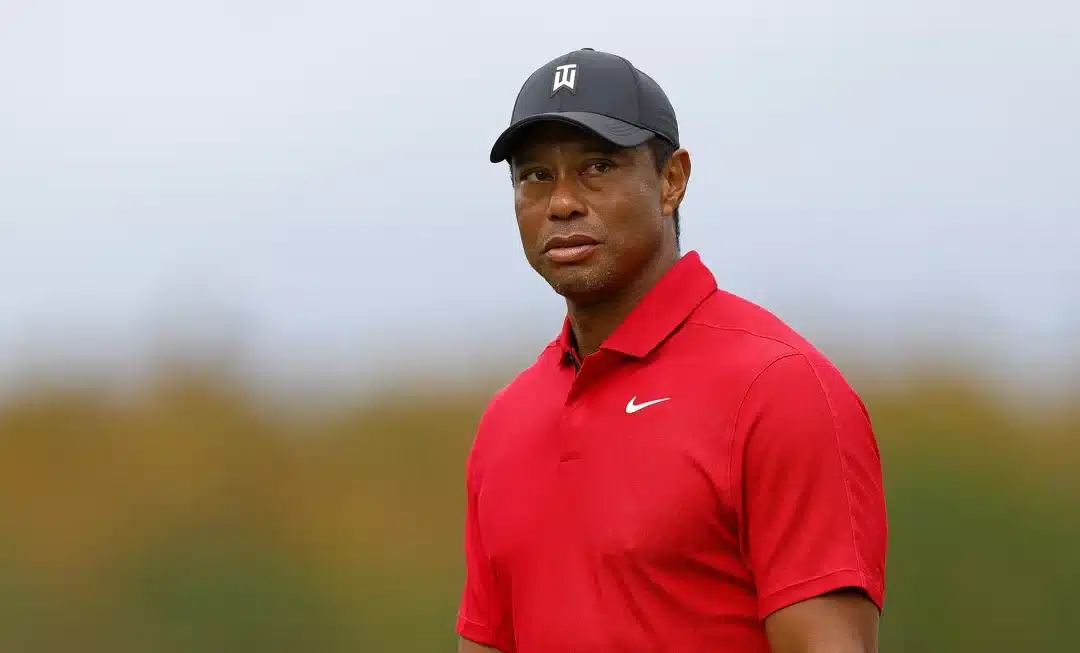
By Brian Sommer
There is, in the modern golf industry, a peculiar and persistent habit of mistaking assertion for evidence. One hears, with almost sacramental regularity, that the game is “growing,” that participation is rising, that interest is expanding, that the sport has never been in finer health. These claims are delivered with the confidence of revealed truth and the scrutiny of none. One is invited to accept them as one accepts the weather: an unexamined condition of modern life. The pandemic, we were assured, only accelerated this renaissance. Fairways filled, tee sheets groaned, and somewhere in the distance a marketing executive declared victory.
And yet, hovering over this narrative like Banquo’s ghost at the feast, stands Tiger Woods – the singular figure without whom this alleged expansion begins to look rather less like a movement and rather more like a moment.
It is here that a crucial distinction is so often, and so conveniently, ignored. Woods did not so much expand participation in golf as he detonated its viewership. He transformed a polite, almost ecclesiastical pastime into appointment television. As Roger Maltbie once observed, with admirable understatement, “it’s just not a fair fight” a remark prompted by yet another act of competitive vandalism, in which Woods treated a championship field as if it were merely decorative.
His fifteen-stroke dismantling at the 2000 U.S. Open was not so much a victory as it was a public demonstration of supremacy rarely witnessed outside of myth.
Or consider Verne Lundquist’s now-canonical eruption during the 2005 Masters, when Tiger Woods’ chip on the 16th at Augusta paused, theatrically, on the lip of the cup before finally conceding to gravity. “Oh, my goodness! … Oh, wow! In your life have you ever seen anything like that?” Lundquist asked, in the tone of a man momentarily convinced he had stumbled into a violation of physics rather than a sporting broadcast.
The answer, strictly speaking, is yes though this is the sort of yes that only pedants and archivists are permitted to offer without sounding disagreeable at dinner. Davis Love III had executed comparable feats at Augusta before. Golf, after all, is not entirely devoid of improbability.
But what renders the moment indelible is not its exclusivity, but its timing, its staging, its almost disrespectful sense of occasion. Woods did not merely reproduce a difficult shot; he chose Sunday afternoon at Augusta National to perform it, en route to a fourth green jacket, as though the script required a flourish, and he alone had read ahead.
And so, the proper answer to Lundquist’s question is both yes and no but with the important qualification that the “yes” belongs to history, while the “no” belongs to memory. We had seen it before. We simply had not seen it insist upon itself in quite that way.
Now, it must be said that the modern professional golfer is not lacking in talent. Scottie Scheffler and Rory McIlroy are, by any rational measure, extraordinary practitioners of their craft. McIlroy has completed the career Grand Slam; Scheffler stands within touching distance of it. But they are not Tiger Woods. Nor should they be expected to replicate a phenomenon that bordered on the singular. The difficulty lies not in their inadequacy, but in the industry’s refusal to acknowledge the difference.
Instead, we are treated to a familiar litany: “the Tour has never been deeper,” “these guys are good,” “the game is healthy.” All statements which might, in isolation, be perfectly true, and yet collectively function as a kind of rhetorical fog obscuring a rather inconvenient reality. For while the depth of talent may indeed have increased, the depth of public fascination has not followed suit. One cannot substitute excellence for inevitability. Woods was not merely great; he was compelling. And compelling, unlike competence, cannot be mass-produced.
During his ascendancy from junior golf, where he won three consecutive U.S. Junior Amateurs and three consecutive U.S. Amateurs, through to his professional debut with the infamous “Hello, World” in Milwaukee the sport did not simply grow. It swelled, distorted, and briefly escaped its natural boundaries. Final rounds of major championships routinely attracted audiences in the range of 12 to 15 million viewers. When Woods so much as hovered near contention, ratings surged as though pulled by gravitational force. When he won as at the Tour Championship in 2018 viewership did not incrementally
increase; it spiked violently upward, approaching figures otherwise reserved for national spectacles.
And then, in his absence, the spell broke.
The same tournaments, staged on the same courses, featuring players of indisputable excellence, quietly reverted to a more modest existence. Regular tour events slipped into the one to three million viewer range. Even the majors those supposed pillars of permanence settled into figures between five and nine million. Numbers which, while respectable in isolation, look rather smaller when placed beside what once was.
This is not a fluctuation. It is a reversion.
To appreciate the scale of this shift, one need only cast a glance beyond golf’s carefully curated garden. The National Football League does not merely compete for attention; it monopolizes it. Regular season games command audiences of 15 to 20 million, playoff contests soar beyond 30 million, and the Super Bowl exceeds 100 million viewers with ritualistic certainty. The NBA Finals and the World Series occupy the 10 to 12 million range territory that Tiger-era golf once brushed against, and modern golf can no longer reliably reach.
And here lies the crux of the matter.
Golf did not experience a sustained expansion of its audience. It experienced a temporary occupation by a singular figure. Woods did not build a broader base of engagement; he concentrated attention so intensely that it created the illusion of growth. When he withdrew through injury, age, and the simple erosion of physical inevitability the audience did not migrate. Itdispersed.
This is the detail most frequently omitted from official proclamations of health: audiences, unlike governing bodies, are under no obligation to remain loyal. They follow compulsion, not instruction.
Consider, if further evidence were required, his most recent great return. At the 2019 Masters Tournament his final major victory Woods drew approximately 10.8 million average viewers in the United States, peaking at nearly 18 million during the decisive stretch on Sunday. In total, more than 37 million people tuned in at some point over the broadcast. These are not merely strong numbers; they are anomalous ones.
Even diminished, even constrained by circumstance, Woods retained the ability to bend attention toward himself.
Nowhere is this more revealing than in the sport’s most recent attempt at manufactured relevance: TGL.
In its first season debut featuring Tiger Woods, the league drew roughly 1.0 to 1.1 million viewers, a figure that immediately stood apart from its own baseline.
By its second season, however, the pattern becomes far more instructive and far less flattering to prevailing myths. TGL has settled into an average audience of approximately 600,000 to 650,000 viewers per match, with many broadcasts fluctuating between 546,000 and 646,000 viewers depending on matchup and scheduling. In other words, a stable but modest audience closer to a niche broadcast than a sporting phenomenon.
Within that context, Tiger Woods’ actual competitive participation in Season 2 produces an outcome that is almost aggressively anti-climactic. Matches in which he appeared, including high-profile fixtures and the finals, did not materially exceed the league’s baseline. They remained within the same ~550,000 to 650,000 viewer band as every other broadcast.
The irony is difficult to miss. The sport’s most gravitational figure, when placed inside a deliberately engineered entertainment product designed to showcase him, generates no statistically meaningful lift in its second iteration.
The comparison, then, is not between presence and absence but between memory and reality.
Even within golf itself, there remains one stubborn exception: the annual pilgrimage to Augusta National Golf Club for The Masters, an event where tradition, ceremony, and mystique conspire to create something approaching cultural significance. But it is telling that the aura of Augusta often eclipses the identities of those competing upon it.
None of this is to suggest that golf is dying. The sport remains financially robust, globally distributed, and structurally sound. But it is emphatically not what it appeared to be during the Woods era. It has not maintained that level of cultural penetration, nor has it replaced the force that created it.
And so, we arrive at the present moment, where the language of growth persists, untethered from the evidence it purports to describe.
There is, in all of this, a rather exquisite irony. For if Woods still
the game’s last remaining gravitational force were to wander, even part-time, into the gentler precincts of the PGA Tour Champions and begin, as he has always done, the unseemly business of winning, the effect would not be to elevate that circuit so much as to further expose the fragility of the PGA Tour itself.
Because what the PGA Tour now finds itself engaged in is not stewardship, but competition not merely with rival golfers, but with capital itself. The vast reservoir of the Public Investment Fund and its blunt instrument, LIV Golf, has forced the Tour into a posture of reaction: elevated events, no cuts, inflated purses, and an increasingly elaborate FedEx Cup apparatus designed, in theory, to manufacture urgency.
In practice, it resembles a committee’s approximation of necessity – what is missing is not money, nor even talent, but inevitability.
And so, at the present absurdity, in which Woods no longer the central actor, but still the central figure hovers over the game like a benevolent specter, he assumes in ventures such as TGL, the role not so much of competitor as of mythological guide: part Yoda, part Obi-Wan Kenobi, dispensing presence rather than dominance, while younger men strike balls into illuminated simulations of consequence.
One is reminded, irresistibly, of the 2008 U.S. Open hobbling, fractured, and somehow inevitable when a putt on the 72nd hole seemed less struck than summoned, forcing a playoff with
Rocco Mediate. It felt less like sport and more like intervention.
Woods is now everywhere and nowhere: no longer capable of sustaining the product through performance, yet still indispensable to its identity.
History offers a cruel contrast. When Jack Nicklaus walked the Swilcan Bridge, or when Arnold Palmer receded into ceremonial reverence, the game did not falter. It simply handed the torch to Woods.
Today, there is no such clarity.
The modern game is replete with excellence and devoid of inevitability. It has not lost the needle – it has discovered that the needle was the point.
And so, we are left with an image that feels less like satire than quiet admission: golf, in all its manicured grandeur, settling back into its natural posture. Not dead, not declining, but contained. A sport of rituals, of afternoons, of selective attention.
One can picture it easily: a veranda, a green-and-white umbrella, and an iced Arnold Palmer sweating gently in the heat while, somewhere in the background, the louder machinery of the National Football League resumes its inexorable calendar.
Golf, at last, unburdened of its brief and unnatural flirtation with mass obsession, returns to what it has always been.
A game.
And, for a fleeting moment, something much more thanks to a man it has not yet figured out how to replace.