
By Brian Sommer
There is something refreshingly honest about a golf course that does not pretend to be Augusta National Golf Club with a homeowners’ association attached.
At Glynlea Country Club, in Port St. Lucie, FL., where Jim Furyk created his first “signature” golf design, this alone distinguishes the project from the sprawling cemetery of celebrity-branded developments littering the American landscape.
The result is something increasingly rare in contemporary golf architecture – a course that remembers golf is supposed to be enjoyable.
Glynlea, which can be stretched to 7,000 yards (par 72), is several intellectual tax brackets above much of modern golf construction, where developers appear convinced that the average golfer secretly longs to spend six hours being waterboarded by forced carries, geometric bunkering, and punitive rough designed by men who confuse suffering with sophistication.
Too many modern courses are built less for human recreation than for aerial drone footage, luxury real-estate brochures, and the emotional insecurities of executives who believe a golf course should function as a hostile environmental audit. One leaves not exhilarated but processed.
Glynlea avoids much of this nonsense.
The routing itself immediately signals a willingness to reject formulaic monotony. Rather than the standard arrangement of four par-3s and four par-5s, golf’s version of suburban zoning regulation the course features five par-3s and five par-5s, creating an unusual rhythm that continuously alters pacing, psychology, and decision-making throughout the round.
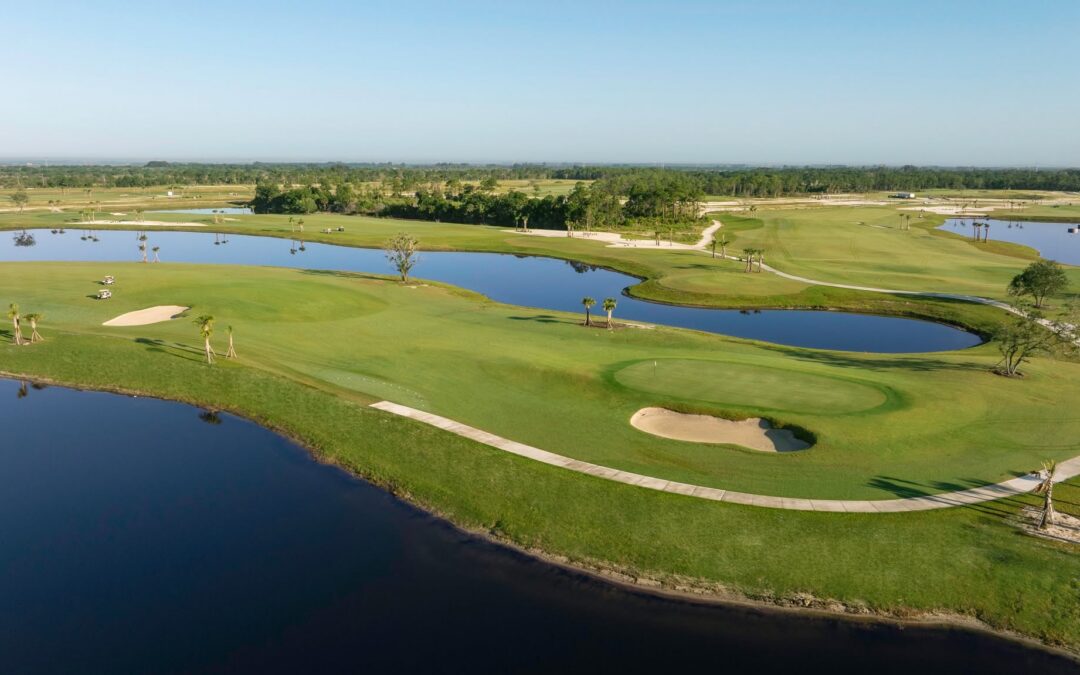
The course possesses movement. It possesses variation. Most importantly, it possesses curiosity and, in a development that may surprise portions of the modern golf industry, enjoyment. The fairways are generous, a feature that should not require praise, yet in the modern age of “championship” vanity architecture, increasingly does. One can actually swing a driver without feeling as though the course architect harbors unresolved personal resentment toward recreational golfers.
The turf itself is firm and delightfully bouncy, encouraging the ground game in a manner far too uncommon in modern American golf, where irrigation systems are often deployed with the enthusiasm of agricultural planners attempting to reverse a drought. The ball runs. It releases. It reacts. One senses interaction with terrain rather than impact into sponge cake.
And the greens possess genuine contour and movement not clownish severity, but intelligent undulation. Putts require imagination rather than merely obedience. One finds oneself studying slopes, angles, and pace instead of simply surviving architectural sadism.
In short, the course asks questions instead of issuing punishments. This distinction matters enormously. Because golf architecture real golf architecture is not merely the arrangement of bunkers and irrigation pipes. It is the construction of decisions. It is psychological engineering conducted through landscape.
The course feature numerous runoffs around the greens, inviting a variety of recoveries, bump-and-runs, lofted pitches, putters from improbable locations, and the sort of creative problem-solving that once formed part of golf’s educational curriculum. There was no USGA-length rough demanding compulsory hack-outs and ritual punishment. Even the native areas are handled with a refreshing practicality acknowledging an obvious truth modern golf often refuses to admit recreational golfers generally prefer finding their golf ball to conducting archaeological excavations.
And here, Furyk appears to understand something that vast sectors of the golf industry have somehow forgotten amateur golfers are not touring professionals. This sounds embarrassingly obvious, rather like reminding people that wine is meant for drinking rather than investment speculation. Yet much of the golf world continues behaving as though the average 14-handicap insurance adjuster from Tampa should somehow aspire to survive the same architectural torment devised for men capable of flighting a 4-iron through a crosswind with the precision of military radar guidance.
Furyk’s own career may explain the difference. He built a Hall-of-Fame résumé not through the modern cult of athletic spectacle but through strategy, adaptability, recovery skills, patience, and an almost irritating capacity to manufacture scores. He was rarely the longest player in the field. He was frequently among the smartest.
The course reflects this sensibility. It rewards positioning over punishment, options over prescriptions, and imagination over obedience. One senses throughout the round that the architecture was informed by someone who spent a lifetime asking not, “How difficult can we make this?” but rather, “How many interesting decisions can we create?”
The course offers challenge without cruelty. Strategy without gimmickry. Difficulty without humiliation. And playable golf, astonishingly enough, turns out to be enjoyable golf. One should not need to write this sentence in the year 2026, yet here we are.
What also struck me was the extent to which the course feels informed by someone who has actually traveled the world and studied memorable golf rather than merely scrolling through high-resolution photographs of famous bunkers on a design consultant’s iPad. One detects influences not through imitation, but through philosophy: width, angles, recoverability, visual intrigue, strategic ambiguity.
Furyk’s fingerprints appear most, clearly not in any individual hole, but in the broader philosophy. The course frequently offers multiple routes to the same destination. Aggression is available but not compulsory. Recovery remains possible after mistakes. The architecture seems less interested in identifying failure than in sustaining engagement.
This is surprisingly rare. Too many modern courses behave like standardized examinations. Furyk’s feels more like a conversation one that occasionally disagrees with you but remains interested in hearing your response.
The holes remain in the memory because they ask you to think. Which brings us inevitably to one of the stranger confidence tricks in modern golf the rise of the so-called “signature course.” The phrase itself should already trigger suspicion. It carries the unmistakable odor of marketing
department cologne.
Somewhere along the way, developers discovered that attaching a famous golfer’s name to a project could instantly manufacture prestige in much the same way mediocre steak houses decorate themselves with black-and-white photographs of Frank Sinatra and pretend proximity to celebrity constitutes culture.
Thus emerged the modern “signature design,” a phrase which frequently means, “A real architect designed this golf course while a famous golfer approved the logo between endorsement obligations.”
This is not universally true, of course.
Jack Nicklaus built perhaps the most expansive architectural empire in golf history, though the sheer industrial scale of the enterprise inevitably raised legitimate questions about how personally involved any human being could remain across hundreds of global developments.
Tom Weiskopf earned substantial architectural respect because people believed he genuinely understood strategic golf and actually spent meaningful time shaping projects in the field. Ben Crenshaw and Bill Coore are admired precisely because they approached architecture less as branding exercise than as ecological stewardship and historical interpretation. Tiger Woods, through TGR Design, appears genuinely engaged in modern strategic concepts emphasizing width, angles, firmness, and playability.
But the broader industry also produced endless developments where celebrity mattered more than architecture. The touring professional might visit the site twice, sketch a bunker complex during lunch, pose heroically for promotional renderings, and then vanish entirely while associate architects performed the actual labor.
Golf remains uniquely vulnerable to this species of prestige theater because the sport is obsessed with symbolic proximity to greatness. Many golfers desperately wish to believe they are participating in something touched by immortality, even if that “touch” amounted to a ceremonial groundbreaking and a framed photograph near the clubhouse Caesar salad station.
Yet genuine architecture cannot be outsourced entirely to celebrity branding. The great courses endure because they create strategic and emotional experiences that deepen over time. They reveal new questions during repeated play. They continue whispering long after fashionable developments have deteriorated into over-watered retirement corridors.
That is why places such as Pine Valley, Royal County Down, Cypress Point, and St Andrews endure in memory long after trendier developments age into irrelevance. The greatest courses do not shout. They linger.
Glynlea seems to understand this better than many vastly more expensive projects.
Perhaps that is because it appears to have avoided the central fraud underlying so many signature developments. The course does not merely wear Furyk’s name like an expensive designer label stitched onto an otherwise generic garment. It feels informed by the strategic values that defined his
entire career. That distinction matters. There is a meaningful difference between celebrity endorsement and architectural authorship.
One is marketing. The other is philosophy. The ultimate compliment one can pay a golf course is not that it was difficult. Difficulty is easy. A narrow hallway lined with poison ivy can be made difficult. The challenge is creating a course that remains interesting after the first impression fades.
Glynlea repeatedly presents choices rather than commands. It asks questions rather than issuing verdicts. The round unfolds less as a sequence of punishments than as a series of negotiations between player, terrain, and imagination.
In other words, it behaves like golf. And there was another pleasant result. I played rather well. Perhaps this was due to the generous corridors, the running turf, the strategic optionality, or perhaps merely the increasingly rare sensation of standing on a golf course that wanted the player to succeed rather than apologize for existing. Whatever the cause, the experience felt liberating rather than adversarial.
There was, however, one peculiarity at Glynlea that deserves special mention, namely, the driving range, which appears less inspired by traditional golf practice than by a late-stage luxury condominium brainstorming retreat conducted after several cocktails.
This was my first experience with a fully aquatic practice facility, floating golf balls, water targets, and the unmistakable sensation that one was preparing not for a round of golf, but for maritime artillery calibration.
The range did feature grass, mats, and of course the mandatory Top Tracer system. Lord heavens, a golfer might otherwise remain disconnected from a glowing screen for nearly eight consecutive seconds.
It is undeniably memorable. It is also faintly ridiculous. Particularly in Florida a state not currently suffering catastrophic land shortages the decision to abandon a traditional practice range in favor of what resembles a permanent Topgolf hallucination feels both curious and deeply revealing about the modern golf economy.
The traditional practice ground grass teeing areas, divots, uneven lies, turf interaction once formed part of golf’s educational structure. Golfers learned trajectory, compression, bounce, spin, and recovery through repeated engagement with actual ground conditions.
There was authenticity to it. The floating-ball range, by contrast, feels optimized less for improvement than for spectacle. It photographs beautifully. It creates novelty. It accommodates evening entertainment and corporate hospitality packages. In other words, it satisfies precisely the incentives driving much of contemporary golf development.
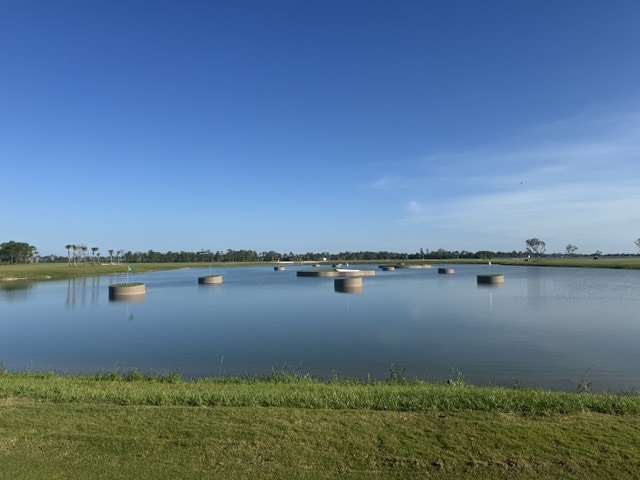
Glynlea’s aqua practice range
Whether it produces better golfers is another question entirely. There is something faintly dystopian about replacing one of golf’s most elemental experiences striking a ball from grass with what feels like a hybrid of aquatic driving range, casino amenity, and luxury apartment complex recreation package.
And yet, to be fair, it was strangely enjoyable.
Watching floating golf balls splash into artificial lagoons produces an oddly childlike amusement somewhere between target practice and carnival psychology. One finds oneself simultaneously entertained and vaguely concerned that civilization may have taken a slightly wrong turn.
Which, admittedly, may describe much of modern golf development in general.
Still, even this eccentricity somehow fits the broader personality of Glynlea itself unconventional, commercially aware, mildly absurd, but ultimately enjoyable. And in an industry increasingly drowning in sterile “signature” vanity projects designed by committee and marketed by PowerPoint presentation, that may constitute genuine praise.
Glynlea possesses something many modern golf courses seem determined to eliminate. Character. Even when part of it is floating in a lake.
Feature Photo Courtesy of Glynlea Country Club