
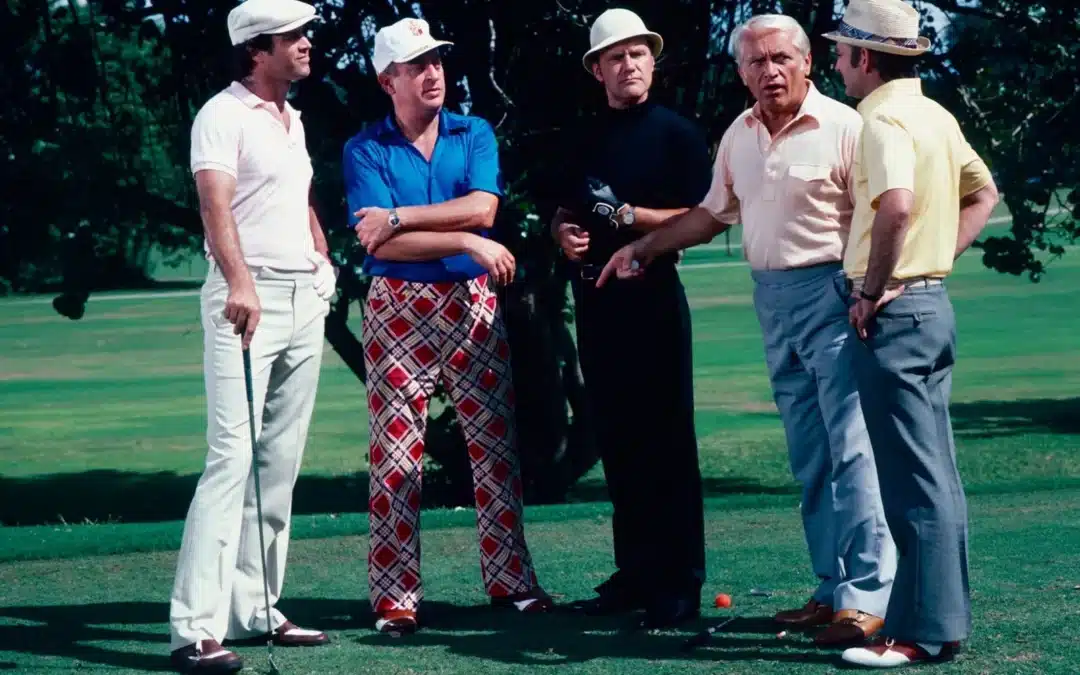
Part I of Dr. Brian Sommer’s look at Golf, Caddyshack, Mulligans, and the Curious Discovery That Nobody Needed Permission to Play
By Brian Sommer, PhD
There are certain places in the sporting world where history announces itself with an almost ecclesiastical solemnity. One approaches Augusta National as though entering a cathedral;,St Andrews as though conducting an archaeological excavation; and Pinehurst as though paying one’s respects to the accumulated wisdom of Donald Ross. At such places, one is expected to appreciate not merely the golf but the considerable historical privilege of being permitted to play it.
And then there is Bushwood. Or, to give the place its less distinguished contemporary name, Grande Oaks Golf Club in Davie, FL. – formerly Rolling Hills Country Club – where much of the glorious 1980 cinematic assault on country-club pretension, Caddyshack, was filmed.
I recently had the pleasure of participating in a charity golf tournament there, and I confess that the opportunity to play the grounds once terrorized by Judge Smails, Al Czervik, and a rather enterprising gopher was sufficient to stir something approaching boyish enthusiasm. There were, regrettably, no gopher sightings. Carl Spackler was nowhere to be found, presumably having exhausted his supply of explosives or been persuaded by the authorities to abandon his more ambitious experiments in
agronomy.
Lou Loomis was similarly absent, and there was no sign of Danny Noonan attempting to reconcile his ambitions for a college education with the disagreeable business of ingratiating himself with the local aristocracy. Nor did I encounter Ty Webb, whose wonderfully irreverent disposition toward golf and life might have made him the most sensible man ever to inhabit Bushwood. I encountered no evidence that Judge Smails was still prowling the premises, dispensing his peculiar interpretation of justice and country-club etiquette. Although, had the opportunity presented itself, I would have struggled to resist offering Ty Webb’s splendid reassurance: “No, Judge, you’re a tremendous slouch.”
There was, however, golf – and a great deal of fun. There were also any number of shots deserving of the immortal encouragement of Mr. Havercamp “That’s a peach, hon!” As the morning progressed, I began to suspect that the old gentleman, whose eyesight was arguably his least reliable faculty, might have understood something about golf that an entire industry of performance specialists has managed to overlook. He was having a marvelous time. Which is considerably more than can be said for many golfers who can actually see where their ball has gone.
The Church of the Pre-Shot Routine
Golf has developed a peculiar relationship with seriousness. What began as an agreeable outdoor pastime involving sticks, balls, and an unreasonable quantity of Scottish weather has gradually acquired the intellectual pretensions of a postgraduate seminar. We are now informed that successful golf requires preparation,
visualization, emotional regulation, breathing techniques, carefully rehearsed routines, and should the entire enterprise go awry, the immediate administration of a mental reset.
The contemporary golfer is encouraged to possess a process for approaching the ball, another for striking it, and a third for recovering from the emotional consequences of having done so. There are frameworks for controlling attention, procedures for establishing confidence, and elaborate sequences intended to ensure that one is sufficiently prepared to undertake the alarming responsibility of hitting a stationary object with a stick. One wonders how golf survived the centuries before anyone thought to furnish it with an operations manual.
And yet, something rather inconvenient occurred during our charity scramble at Bushwood. People played golf. They played while laughing, conversing, joking, and occasionally enduring insults from complete strangers. They played without displaying much reverence for the sacred pre-shot sequence or the elaborate psychological choreography now frequently presented as indispensable to competent performance. A golfer would step onto the tee, look toward the fairway, conclude a conversation of dubious intellectual merit, address the ball, and hit it. Sometimes beautifully, sometimes disastrously, and often with the sort of mediocrity that constitutes a perfectly respectable morning of golf.
The ball, apparently unaware that its owner had neglected several important psychological obligations, behaved much as golf balls have always behaved. It went somewhere, and the golfer continued playing. Nobody seemed especially concerned that they had accomplished this without first consulting themselves about
whether they were ready.
I suspect Ty Webb would have found the whole contemporary enterprise rather amusing. Here was a character who treated golf with considerable affection but refused to accord it the suffocating solemnity demanded by its more distinguished custodians. His peculiar brand of philosophy, delivered to an understandably bewildered Danny Noonan, was itself something of a parody of the human inclination to make mysterious that which might otherwise be experienced directly. The trouble, of course, is that were Ty Webb to appear on social media today, somebody would almost certainly package his eccentricities into a seven-step performance framework, arrange a series of workshops, and offer a certificate upon completion.
The joke would have ceased to be a joke.
Four Golfers, One Ball, and a Suspension of Orthodoxy
For the uninitiated, a scramble is a particularly civilized variation of golf in which several players form a team, each hits a shot, and the group selects the most agreeable result from which to continue. It is a format that might have appealed to the more mischievous philosophers of the Enlightenment. Personal failure is redistributed among the collective, individual brilliance is appropriated for the common good, and the tyranny of one’s own score is temporarily suspended. It is perhaps the only form of collectivism in which I have participated with unqualified enthusiasm. There are obvious limitations to such an arrangement. A scramble is hardly a rigorous examination of an individual’s ability to negotiate eighteen holes. One is spared many of the
unpleasant consequences of one’s poorer decisions. But this is precisely what makes the format interesting.
Consider the driver.
Under ordinary circumstances, a golfer might approach a short par four with a sensible consideration of fairway width, preferred approach distance, hazards, wind, and the various tactical doctrines currently enjoying fashionable approval. There are perfectly legitimate reasons to select a fairway wood, hybrid, or iron. In a scramble, however, these considerations are frequently subordinated to a more primitive and altogether delightful human impulse. Out comes the driver. It comes out on the long holes, the short holes, the narrow holes, and occasionally on holes where its appearance constitutes a fairly convincing argument against the judgment of the person wielding it.
Why? Because hitting a driver is fun.
I realize that this explanation may strike some of the more intellectually ambitious golf strategists as insufficiently sophisticated. There are no dispersion patterns attached to it, no strokes-gained calculations, and no statistical justification for the pleasure derived from the undertaking. Nevertheless, there it is. It is fun to see how far a golf ball can travel. It is fun to attempt something adventurous. It is fun to discover whether a shot is possible rather than dismiss it on the grounds that a less interesting alternative offers a more favorable probability. There is also something quite enjoyable about standing on a tee with a driver in one’s hands, contemplating a shot that prudence might otherwise discourage. The attraction lies partly in not knowing what will
happen. To eliminate every unnecessary risk from the game would be to eliminate a considerable portion of its entertainment.
The scramble provides permission to explore possibilities that golfers might otherwise decline to entertain. What interests me is why we so often require the permission. This does not mean the driver is always the appropriate club. It means that strategic correctness is not the sole reason human beings play games. Golfers are entitled to enjoy the activity even when their decisions fail to withstand the scrutiny of an accountant.
The Mulligan and Other Articles of Faith
Of course, no serious discussion of charity scramble golf would be complete without acknowledging the most important club in the bag: the mulligan.
The mulligan is a marvelous little instrument of human optimism. It allows us, for a modest charitable contribution, to purchase temporary immunity from the consequences of our own incompetence. It is the golfing equivalent of a religious indulgence, although the transaction is rather more transparent, the proceeds generally go to a better cause, and nobody makes any extravagant promises about the afterlife.
Our foursome made particularly distinguished use of this privilege on one green, where we confronted an eight-foot putt for birdie. Four golfers. Eight feet. Additional attempts at our disposal. What could possibly go wrong? We proceeded, with admirable efficiency and a degree of collective consistency that would surely impress a motor-learning specialist, to miss the putt eight consecutive times.
Eight.
I remain unconvinced that Carl Spackler had actually cut a hole in that particular green. The possibility of subterranean interference by the aforementioned gopher cannot, in my estimation, be entirely dismissed. What made the episode especially amusing was that we possessed the accumulated intelligence of four golfers, the opportunity to observe the preceding attempts, and the considerable advantage of being permitted to try again. Each unsuccessful putt provided additional information, and each subsequent golfer was the beneficiary of it. By the eighth attempt, we had subjected those eight feet of Florida real estate to an inquiry of almost congressional proportions, accumulated a respectable body of evidence, and achieved absolutely nothing. The only matter that remained unresolved was the one for which the inquiry had originally been convened: getting the bloody ball in the hole.
There is something rather instructive about this. Golfers are regularly encouraged to believe that acquiring additional information necessarily produces better performance. Yet here we were, accumulating information at an impressive rate while accomplishing precisely nothing on the scorecard. We could observe the break, judge the speed, watch the behavior of the ball, and make whatever adjustments we considered appropriate. But none of this relieved the next golfer of the responsibility of actually playing the putt. Reading a green and putting a golf ball are related activities, but they are not the same activity. By the time of our final attempt, we had the considerable advantage of having witnessed seven demonstrations of how not to make the putt. What we did not possess, despite this accumulation of empirical evidence, was any assurance that the eighth would go in. Each
golfer still had to encounter the putt anew, relate to the target, and play it. The previous attempts could inform the next one, but they could not play it.
Had Danny Noonan been available, I suspect we would have gladly solicited his services. As for Ty Webb, his unconventional approach to putting might have been worth entertaining, although by that stage we had exhausted any authority we might otherwise have claimed on the subject.
Nor does a second attempt constitute a repayment of some debt incurred by the first. The golf ball does not owe us a better result on account of our previous disappointment. Nature has no obligation to compensate us for our mistakes, however generously we have contributed to charity.
The mulligan provides another opportunity to play, not an entitlement to a more agreeable result. And perhaps the most enjoyable aspect of our collective failure was that it remained exactly what it was: eight missed putts. We laughed. We moved on. Nobody diagnosed a putting disorder, recommended a change of grip, or suggested that our collective inability to make birdie revealed some deficiency of character. Had we been attending a performance seminar, I suspect we could have occupied the remainder of the morning investigating what was wrong with us. Instead, we went to the next tee.
The Hecklers of Bushwood
On two holes, the tournament organizers had arranged for announcers to provide a running commentary on the participants. Their contributions consisted of jokes, insults, off-color remarks,
good-natured ridicule, and various other forms of public humiliation. It was, in other words, precisely the atmosphere one would have hoped to encounter at Bushwood.
There is something magnificent about attempting to hit a golf ball while a complete stranger, equipped with a microphone and apparently unencumbered by the conventions of polite society, questions your competence, your judgment, your choice of attire, and possibly your ancestry. One could almost imagine Rodney Dangerfield wandering onto the tee to provide some additional observations. The organizers had, perhaps inadvertently, recreated something of the original Bushwood experience. All that was missing was Judge Smails threatening disciplinary action and Al Czervik offering to purchase the establishment.
But what interested me was not merely the entertainment. It was that the golfers continued to play.
Here was an environment containing many of the conditions that golfers are routinely advised to manage, avoid, or neutralize. There were distractions, interruptions, an audience, the possibility of embarrassment, and people deliberately interfering with whatever tranquility the golfers might have possessed. Yet shots were hit. Some were excellent, others were not, and laughter accompanied both. Nobody appeared to require a psychological reconstruction before addressing the ball. There was no collective retreat into breathing exercises, no formal declaration that the atmosphere had compromised performance, and no demand for the announcers to remain silent until the necessary conditions for hitting a golf ball had been restored.
It would be perfectly understandable for a golfer to prefer silence while playing a shot. What is rather less understandable is the intellectual leap from preferring silence to requiring it. The former is a matter of personal preference; the latter is a claim about human capacity, for which one might reasonably request some evidence. At Bushwood, we were afforded neither silence nor dignity, and somehow managed to play golf without either.
Now, a charity scramble is not a controlled experiment, nor is it equivalent to standing on the eighteenth tee with a major championship at stake. I would no more claim that a morning at Bushwood disproves sports psychology than I would claim that our eight missed putts establish the futility of putting instruction. But the observation remains interesting. Golfers were demonstrably capable of playing amid surroundings that were anything but orderly and with preparations that bore little visible resemblance to the elaborate procedures frequently prescribed for them. Perhaps human beings are rather more capable than the literature written on their behalf sometimes permits them to be.
Golf Without the Permission Slip
There is something wonderfully appropriate about having encountered all of this at Bushwood. A golf course immortalized by a film that subjected the pretensions of country-club life to merciless ridicule had, some forty odd years later, provided an occasion to reconsider a few of the more fashionable pretensions of contemporary golf.
We had attempted drives that prudence might have discouraged,
purchased absolution in the form of mulligans, missed eight consecutive putts from eight feet, and endured the indignity of having our athletic abilities and sartorial judgment publicly questioned by strangers with microphones. And yet, somehow, golf had been played. There had been no great revelation, no breakthrough in human performance, and certainly no evidence of a newly discovered putting technique. What there had been was a thoroughly enjoyable morning in the company of other golfers, none of whom appeared particularly concerned with acquiring the psychological qualifications necessary to participate.
I suspect Ty Webb would have found our proceedings entirely agreeable. Judge Smails, considerably less so.
But beneath the comedy of the occasion lies a rather more interesting question. If human beings are already capable of playing golf amid such magnificent disorder, what precisely are we attempting to provide them with when we insist upon so much preparation?
That question deserves rather more consideration than the eight-foot putt we so comprehensively failed to make.