
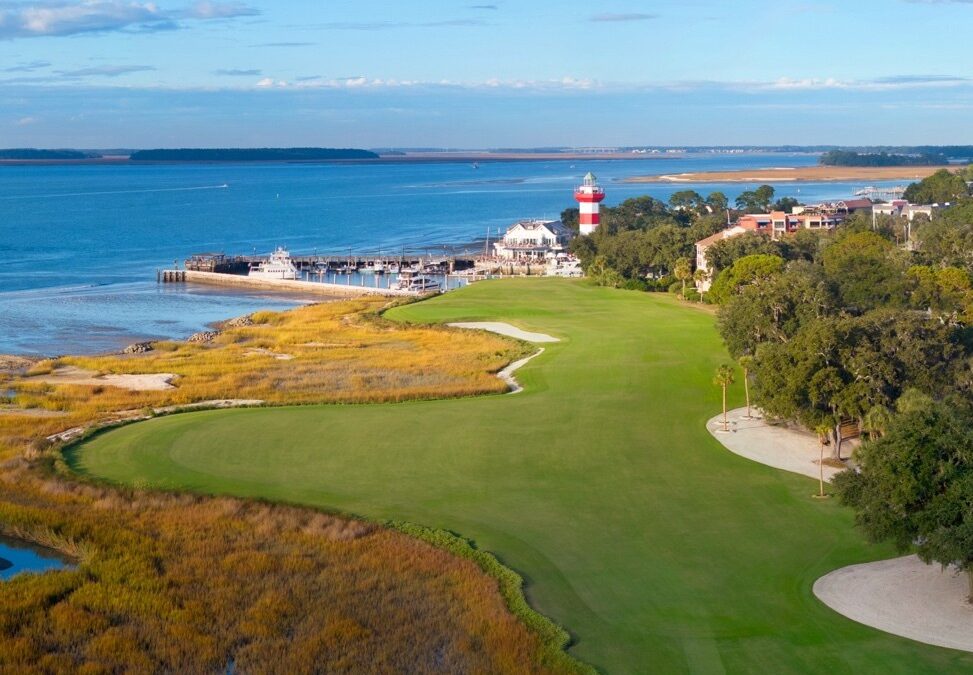
Part I of Brian Sommer’s four-part series on Harbour Town Golf Links
By Brian Sommer
More than half a century after its debut, Harbour Town remains one of golf’s most persuasive rebukes to the modern superstition that greater length must mean greater difficulty, and that greater difficulty must mean greater architecture.
It does not.
A golf course can be long and still be dull. It might be punishing and still be witless. It might be spectacular from the clubhouse terrace and intellectually vacant from the fairway. Harbour Town avoids all three sins. Its genius lies not in overwhelming the golfer, but in involving him. It asks for precision, angles, imagination, judgment, and an honest reading of what is actually present.
Its 2025 restoration – led by Davis Love III – matters because the thing being preserved is not merely a collection of green shapes, bunkers, trees, and timber bulkheads.
It is an idea about golf.
Opened in 1969 at The Sea Pines Resort on Hilton Head Island, S.C., the course demonstrates that championship golf did not require colossal length, elevated greens, enormous bunkers, broad corridors, or earthmoving on the scale of civil engineering. It could defend itself with small targets, mature trees, angled greens, changing wind, and the delayed consequences of seemingly minor decisions. It could ask questions rather than issue commands.
That distinction is central to why Harbour Town remains my favorite Pete Dye course – ahead of the Ocean Course at Kiawah Island, the Stadium Course at TPC Sawgrass, PGA West’s Stadium Course, and Kingsmill’s River Course. Each is memorable. Kiawah exposes the golfer to wind, scale, and the elemental force of the coast; Sawgrass turns strategy into psychological theater; PGA West makes punishment visually unavoidable; Kingsmill asks quieter questions through its routing, contours, and river setting.
Harbour Town does something more restrained, and therefore more difficult to explain. It draws the golfer into a relationship with the course. It does not tell you what shot to play. It allows you to choose, then permits reality to reveal the quality of that choice.
That is also what I value in equipment, instruction, and learning. The most useful question is not whether a method is modern, popular, scientific, Tour-proven, data-driven, or endorsed by a celebrated coach. These labels are often used not to illuminate an idea, but to spare it from examination.
The more important question is this, does this increase my contact with reality, or does it ask me to substitute someone else’s certainty for my own observation?
Coaching rarely begins there. It more often begins with a method, system, theory, drill, key, model, or anecdote about what another golfer experienced. The golfer is told what the swing should be before anyone has shown sufficient curiosity about what the golfer is already doing.
Description becomes prescription.
An observation is promoted into an explanation. An explanation is promoted into a cause. A cause is then treated as universal because someone with credentials said it confidently. The golfer’s direct experience is quietly subordinated to the authority of the coach, the technology, or the system.
Harbour Town proceeds in the opposite direction. It does not provide certainty. It provides information. It does not insist on one route. It presents choices with consequences. It does not replace judgment. It demands it. That is why the course remains so compelling. It preserves the sovereignty of the golfer.