

You know the old saying: “You don’t tug on Superman’s cape?’’ The same can be said about Teeth of the Dog. That is, you don’t mess with a Pete Dye classic. The statue of Dye that stands at the entrance to Teeth of the Dog is a bronze reminder of the legendary architect’s prowess and place in the Dominican Republic.
During his restoration of the fabled course at Casa de Campo Resort & Villas, Jerry Pate didn’t tug on ol’ Pete’s cape as much as he just smoothed out a few wrinkles.
Carved out of coral rock – and with seven holes playing hard against the Caribbean Sea – Teeth of the Dog opened in 1971 and set the tone for destination golf in the Caribbean.
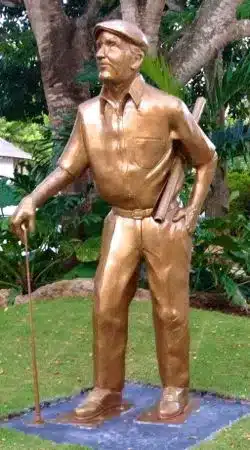
Pete Dye Statue at Casa de Campo (Casa de Campo)
Pate’s $15 million renovation reinforces Teeth of the Dog’s place as the top course in the Caribbean, as well as strengthens Casa de Campo’s reputation as the Caribbean’s premier golf and recreation destination. The resort also features two more Dye courses – Dye Fore and Links – as well as nearly 300 guest rooms and suites.
Don’t pass on either, particularly Dye Fore, which is set on the cliffs above the Chavon River Francis Ford Coppola used the river as a filming site for his 1979 epic, “Apocalypse Now.’’
It’s Teeth of the Dog, however, that garners most of the attention. Just stand on the tee box of the seventh hole, a par three that can play as long as 227 yards – with the waves crashing on the beach and rocks – and you’ll know why. You’ll also easily figure out why Pete and Alice Dye had a bungalow-style home a few yards to the right of the green on the seventh hole.
“It’s not often you get to take a masterpiece like Teeth of the Dog and make it better,’’ said Jason Kycek, the resort’s chief marketing officer.
The project included the removal of tons of aging topsoil and complete re-grassing with saltwater tolerant Dynasty Paspalum, which provides a dark green color and is ideal for golf courses and sports fields. Dye, by the way, was among the early adapters as paspalum grasses, which first came to prominence on his layout at the Ocean Course at Kiawah Resort near Charleston, S.C.
“We couldn’t think of a better person to do the job,’’ Kycek told me. “Jerry is a legendary golfer and successful architect. And he had a great relationship with Pete Dye.’’
Many of the changes made by Pate and his team are subtle. For example, three inches of sand was added to the fairways to improve drainage and playability; the greens are sharper and restored to their original sizes; and a new irrigation system is throughout the layout.
Among the more visible changes: Pate added more breakers off the coast of the “Heaven 7’’ holes for more dynamic views; restored each of the 127 bunkers; revitalized each tee box; and built complete full golf car paths – although the way Pate put them in, none take away from the beauty of the course.
In addition, a fully-stocked concession stand was constructed – sort of a preview of the resort’s commitment to elevate its food and beverage offering throughout the 7,000-acre property, which will begin Phase Two of its luxury Premier Suites project.
But for now – and most of this year – Kycek said, “It’s all about Teeth.”
“The renovation has been a special project for me and the entire team, and it’s definitely changed – for the better – the legacy of Pete Dye and the resort as a whole.’’
Feature Photo: Teeth of the Dog (Jerry Pate Design)