
By Brian Sommer
There is a peculiar modern superstition in golf: the belief that any human difficulty, including putting, can be solved if one simply applies enough engineering to it.
If the ball does not start online, the answer is alignment. If alignment is inconsistent, the answer is perception. If perception is inconsistent, the answer is a more advanced system explaining why perception itself is failing. And if that still does not work, then the answer is yet another system designed to correct the deficiencies of the previous one. At no point does the industry seriously entertain the possibility that the problem might not yield to the form of solution it insists upon applying. And so, we arrive, once again, at golf’s most enduring obsession: the belief that putting can be perfected through geometry.
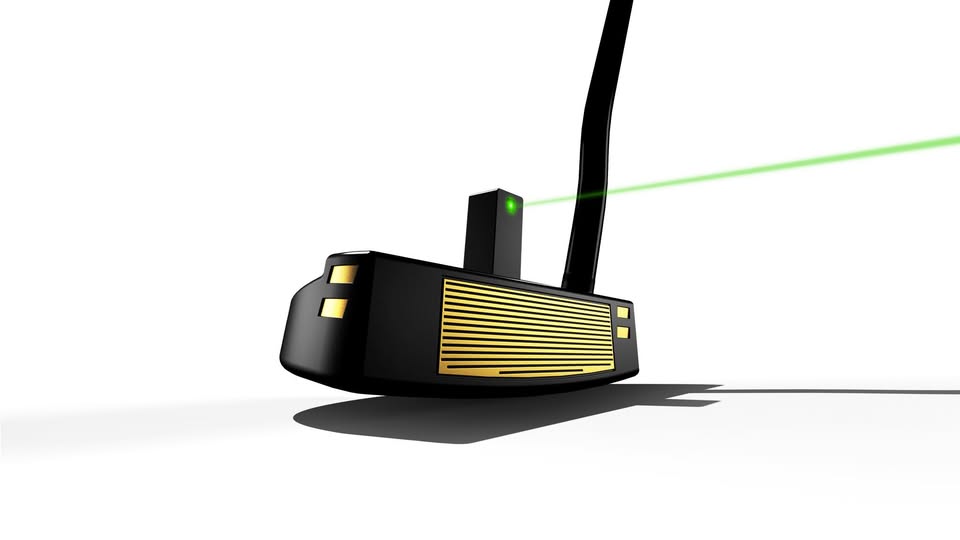
The latest and perhaps most ambitious expression of this belief is the Chamber Justice Mallet and A-LOC System Kit, a device so elaborate in its diagnostic ambition that it is no longer entirely clear whether it is a putter with a fitting system attached, or a fitting system that has reluctantly tolerated the presence of a putter.
Having spent time with it testing it, rotating through its configurations, experimenting with the laser, and observing both its claims and consequences one is left with a complicated impression. It is intelligent. It is serious. It is also a remarkably precise epitome of modern golf’s central confusion.
Traditional putters attempt to refine feel, stability, acoustics, orroll. Chamber attempts something more intrusive – to diagnose how you see. Its central thesis is unmistakable. You are not aiming correctly because you are not perceiving correctly. From that premise, everything follows. Interchangeable alignment plates. Multiple visual geometries. Full-color systems. Lines. Triangles. Red and white configurations. A detachable laser designed to verify aim with clinical authority. The golfer is invited to rotate through roughly ten visual permutations in search of perceptual truth.
This is not merely equipment. It is an optical calibration exercise disguised as golf.
And one must admit it is compelling. The laser is fascinating. The experimentation becomes intellectually addictive. One begins testing not only the putter, but oneself. Which geometry feels square? Which shape inspires confidence? Which visual language appears most stable to the eye?
But this is also where the philosophical problem quietly enters the room.
Because the Chamber system does not merely suggest that lasers are accurate – they are. It suggests something much larger: that human perception itself is fundamentally unreliable and requires continuous external correction.
Once that premise is accepted, something subtle but decisive occurs. The golfer stops learning to see and begins learning to verify. There is a difference. A profound one. The modern alignment industry has quietly transformed putting from an athletic skill into a perceptual management problem. And
Chamber is simply the most advanced expression of a much older impulse.
Golf has been producing alignment solutions for decades. Chalk lines stretched across greens like moral absolutes. Mirrors transforming putting practice into forensic investigations. Gates built from tees. Alignment sticks multiplying on practice greens like invasive species. Training aids promising optical certainty through repetition and mechanical obedience.
And now even the golf ball manufacturers have joined the calibration economy. What began years ago as a modest side stamp has evolved into a full-scale visual assistance program. Modern golf balls now arrive decorated with triple-track systems, elongated alignment corridors, arrows, framing geometries, and high-contrast directional markings designed to transform the golf ball itself into yet another instrument of optical reassurance.
The implication is unmistakable: not only can the golfer apparently not be trusted to aim the putter unaided, he also cannot be trusted to orient the golf ball. The golfer is now surrounded by corrective architecture at every stage of the process. Alignment lines on the putter. Alignment lines on the golf ball. Mirrors for eye position. Lasers for face angle. Systems for posture. Systems for stroke path. Systems for visual bias.
Each reinforces the same proposition that your natural perception is insufficient. And yet this escalating accumulation of assistance raises an awkward question the industry rarelypauses long enough to ask: If golfers already possess alignment lines on the putter, alignment lines on the golf ball, mirrors for setup, lasers for aim, and increasingly sophisticated perceptual fitting systems, at what point does one more alignment technology cease solving a problem and begin merely perpetuating an anxiety?
Because one begins to notice something peculiar about the modern golfer. He now stands over a six-foot putt armed with more visual information than previous generations possessed in an entire practice session yet appears no more liberated from doubt.
Indeed, perhaps less so.
The problem with perpetual calibration is that it conditions the golfer to distrust unassisted awareness. Every additional line implies another opportunity for misalignment. Every new visual aid quietly reinforces the suspicion that perception itself is unreliable. And this may explain why the search for perfect alignment never reaches conclusion.
The industry cannot truly afford resolution. A solved anxiety is commercially useless. So, the cycle continues. More systems. More diagnostics. More optical reassurance. More attempts to engineer certainty into an activity whose defining feature is uncertainty.
This does not make the systems fraudulent. Many are thoughtful. Some are genuinely useful. Chamber itself is intellectually serious and technically impressive. But collectively, these technologies reveal something revealing about modern golf culture: its growing discomfort with ambiguity itself. Earlier systems, such as SeeMore’s RifleScope Technology, at least possessed the virtue of restraint. Align the shaft. Hide the dot. Repeat. No perceptual profiling. No optical matrix. No attempt to transform putting into a diagnostic science. This distinction matters because there are now two competing philosophies in modern putting.
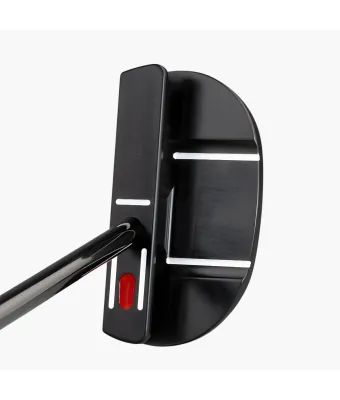
SeeMore Putter with Rifescope Technology (SeeMore)
One seeks to stabilize perception. The other seeks to endlessly optimize it. Chamber belongs firmly to the latter. Across the industry from Chamber to Ping Scottsdale TEC systems, Evnroll alignment technologies, and the broader ecosystem of optical fitting, the same assumption persists: perception can be engineered.
But what happens to learning when perception is no longer explored, but managed?
There was a time when golfers learned alignment through experience rather than technological intervention. They observed misses. They experimented intuitively. They developed a relationship with target and space through repetition, frustration, and gradual awareness.
Alignment was not delivered. It was discovered.
That distinction matters because discovery is developmental. It builds internal calibration through lived feedback. Systems, by contrast, externalize calibration. They tell the golfer what is happening before the golfer has had the chance to learn it.
To be fair, the Chamber system can absolutely be used
productively if approached as an aid rather than an authority. Used properly, it can illuminate tendencies the golfer may never have noticed otherwise. But modern golf technology rarely remains a suggestion for long. It has a habit of quietly becoming doctrine.
And this is where the Chamber system becomes most revealing. It is not merely a tool for alignment. It is a tool for interrogation. How do you see square? Do colors alter perception? Does geometry distort aim? Does head shape manipulate visual bias? These are legitimate questions. But systems like Chamber risk turning exploration into dependence.
The golfer begins seeking verification rather than understanding. He learns to distrust unaided perception. He fears uncorrected aim states.
At that point, the system no longer expands awareness. It replaces it. And yet something important complicates this critique. During testing, what proved most revealing was not the interchangeable plates or the color systems, but the head shapes themselves.
Using the Chamber laser on other putters, including a TaylorMade Spider X, an Anser-style blade, and an older Scotty Cameron Laguna, a pattern emerged almost immediately. The blade-style putters repeatedly aligned more naturally to perceived center. The Spider appeared slightly left. The Chamber mallet, more significantly, often sat a ball or more left unless consciously manipulated back into position.
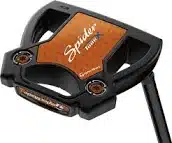
Spider X Putter (TaylorMade Golf)
This is not a defect. It is a consequence of geometry. Head
shape matters. The assumption that mallets are universally easier to align is, at best, incomplete. Easier to stabilize is not necessarily easier to perceive. This is the uncomfortable truth modern design often avoids. A mallet might MOI. It might reduce face rotation. It may improve forgiveness. None of these guarantees that it presents squarely to the human eye.
And the eye, inconveniently enough, remains the final arbiter.
There is a reason some of the greatest putters in history – Tiger Woods, Ben Crenshaw, and Brad Faxon – each spent their careers with blades. Not because technology failed to advance, but because those shapes preserved a cleaner relationship between eye and target.
The modern mallet increasingly behaves less like a tool and more like a visual management system. It frames perception. Guides it. Corrects it. Sometimes overwhelms it. And here lies the deeper paradox. Despite decades of lasers, mirrors, alignment corridors, visual systems, and perceptual diagnostics, there is remarkably little evidence that golfers as a population are dramatically better at alignment than before. They are better equipped. Not necessarily better at seeing. Which raises the more uncomfortable possibility that alignment, as the industry frames it, may not be the central problem at all.
Because the real question is not whether alignment can be perfected. It is whether obsession with alignment is itself a misdirection.
Again, to be fair, I enjoyed experimenting with the Chamber system immensely. I enjoy tinkering with putters, golf balls, and
golf technology generally. For someone inclined toward experimentation, the system is genuinely fascinating. But I am probably not the ideal litmus test. Most golfers are not looking for a $700 perceptual audit. For many, golf is simply a social ritual that gets them outdoors a few times a month. The notion of systematically rotating through visual permutations in pursuit of optical certainty may strike them not as enlightening, but exhausting.
And perhaps that is the final irony of the modern alignment movement. The more elaborate the systems become, the farther they drift from the simple reality they claim to improve. Because uncertainty is not the obstacle to putting. It is the condition of it. And so, the debate ultimately resolves not in better lasers, better geometries, or more elaborate calibration systems, but in something both simpler and more difficult: Whether the golfer is willing to move from trying to achieve correct alignment to learning how to relate to the putt in front of him.
Because in the end, after all the diagnostics have been completed and all the visual permutations exhausted, something stubborn remains: A ball. A putter. A target. And a human being who must decide whether to trust what he sees or continue outsourcing that trust to systems insisting they see better on his behalf.
Feature Photo Courtesy of Chamber Putter