
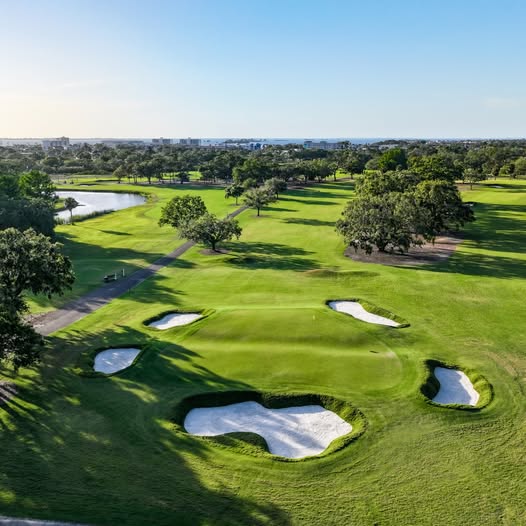
A lot of golf course restorations (or renovations) these days tout taking the layout back the original design vision of its creator. That sounds good, but many times, one has to squint to recognize the before and after differences.
Dunedin (FL) Golf Club is exactly the opposite. Donald Ross’s original design vision shines thanks to Kris Spence’s 2024 restoration of the master’s 1926 achievement (the course opened Jan. 1, 1927) in the Florida Gulf Coast near Tampa.
The restored course re-opened in February 2025 with Rossian rolling greens and bunker complexes that are as easy to recognize today as they were when Ross walked the lines of what opened as Dunedin Isles Golf Club.
“That’s why we don’t call it a ‘renovation,’’’ said Dunedin Golf Club General Manager Blair Kline. “We call it a ‘restoration.’ Ross aficionados who have been here go absolutely nuts about our greens complexes.’’
Kline looked out of the door of his office towards the first tee.
“This is the layout,’’ he said. “We didn’t make a par-5 and par-3 or anything like that. Everything stayed the same. We found the original greens. We only gained about 100 yards in the restoration. We would have liked more, but there was not much more available.’’
A main goal of the $6.2 million project, Kline said, was to honor Ross’s legacy. Using Ross’s field notes and plans Spence found at the Tufts Archives in Pinehurst, N.C, that goal certainly was accomplished.
But is the restoration “exact’’ to Ross’s plans?
Kline, unapologetically, says “No.’’
“Before he died (in 1948) Ross was changing the contours of a lot of his greens because they weren’t the same as the original designs. So, I have a hard time telling people that we put the ‘exact’ course out there, because I think that if Ross today saw how far the ball goes and saw the greens speeds of courses, he wouldn’t design the same golf course that’s there.’’
With six sets of tees, the course (par 72) plays as long as 6,766 yards and as short as 4,593 yards.
“These are Donald Ross’s bunkers and his greens complexes,’’ Kline said. “Those truly are the Ross greens complexes because of how Kris Spence did them. The difference is, Kris Spence didn’t use over a four-degree slope on any of the greens. Whereas they might have been rolling (on a Stimpmeter) five, six or seven in Donald Ross’s day, they now are normally around 10 or 10 and a half.
“If we get them any faster – and put the pins in certain locations – but you’ll be out there a while.’’
Not only is Dunedin Golf Club – one of only three Florida courses on the National Register of Historic Places – a testament to Ross’s genius, it’s also a prime example of, when done correctly, a municipality can successfully own and operate a golf course.
The City of Dunedin has owned it since 1938. The PGA of America basically operated the course from 1945-62 as its national headquarters. The course was even called, “PGA National Golf Club,’’ during that time.
Dunedin Golf Club has hosted 18 Senior PGA Championships, as well as the first “trunk’’ show that now is the annual PGA Show in Orlando. Baba Zaharias played at Dunedin Golf Club. So did Byron Nelson and Sam Snead.
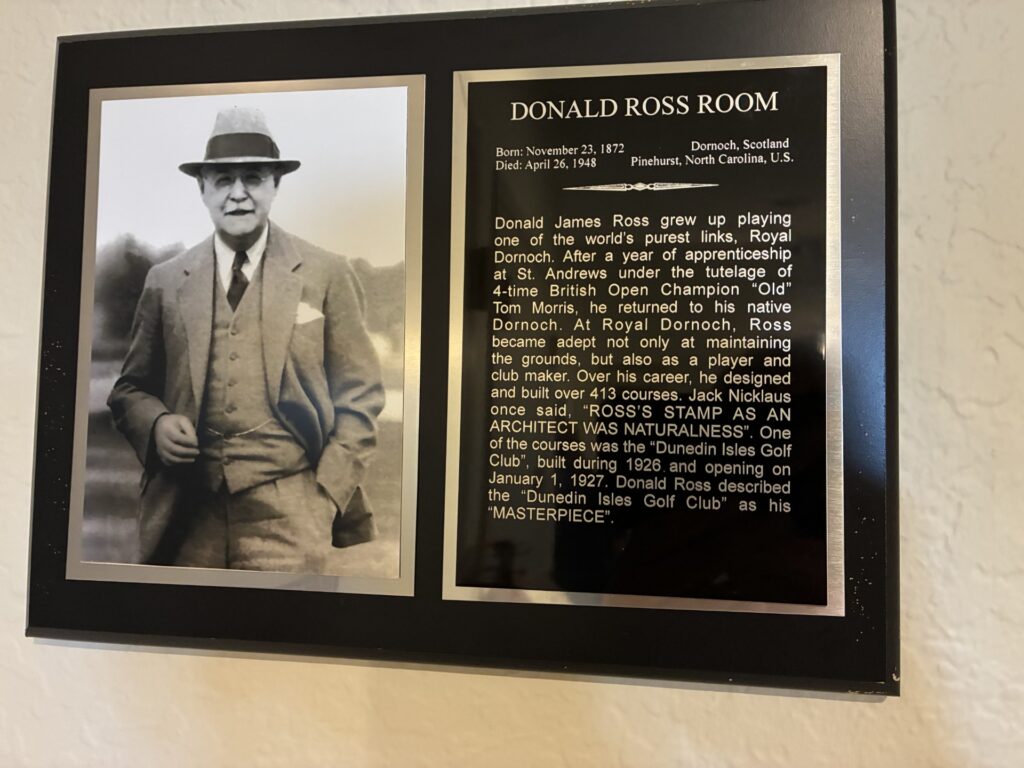
Kline, a long-time PGA professional, has been at the club for nearly four years. He was brought in originally to oversee the restoration. Among his current projects is creating a “Donald Ross Room’’ that shows off the history and heritage of Dunedin Golf Club.
“There wasn’t much Ross left out there,’’ prior to the renovation. “I love construction. I’ve worked on golf courses all over the country. This fits nicely into what I like.
“There are other Ross courses in the area (including legendary Bellaire CC, about 20 minutes south), but to get on them is tough. This is a Ross course that you play.’’
And one where you can see the master’s genius.
Feature Photo Courtesy of Dunedin Golf Club