
By Brian Sommer
It is not often that one gets the opportunity to play a golf course few know about exist. More rare is to discover one whose existence has escaped notice entirely, which seems perfectly appropriate given the name and the location.
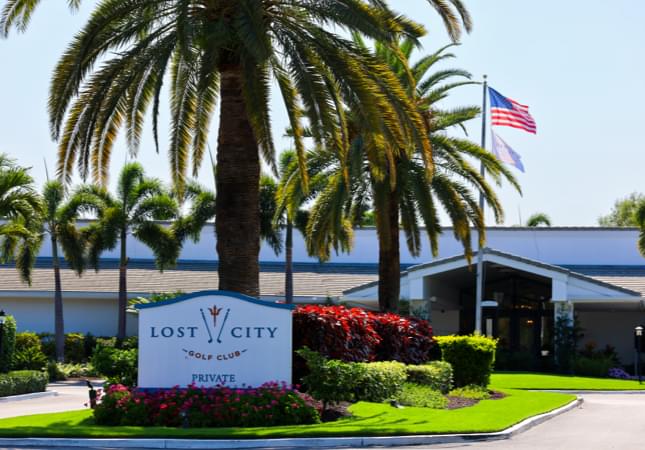
Tucked quietly into the rear of a South Florida municipality bearing the improbably ambitious name of Atlantis sits Lost City Golf Club a members-only course, whose presence feels like a minor act of rebellion against contemporary golf culture.
Rising gently from the flat coastal landscape, it is not quite El Dorado, though neither is the comparison wholly misplaced. Hidden treasure perhaps. An increasingly uncommon discovery in a sporting world now convinced that significance must announce itself loudly, carry a corporate sponsor, and arrive accompanied by drone footage and social media strategy.
You do not stumble upon Lost City. You find it. And in finding it, one is reminded that golf once existed before branding consultants discovered adjectives. The place feels immediately and unapologetically old Florida. No cathedral clubhouse. No faux-European architecture. No self-conscious declarations of luxury.
The facilities resemble something preserved from another age, 1960s Florida country club architecture untouched by the modern obsession with making every golf club resemble either a resort in Scottsdale or an airport lounge. One half expects legendary caddie master Lou Loomis to emerge from behind the bag room assigning loops to an assembled caddie corps while chain-smoking and dispensing life advice.
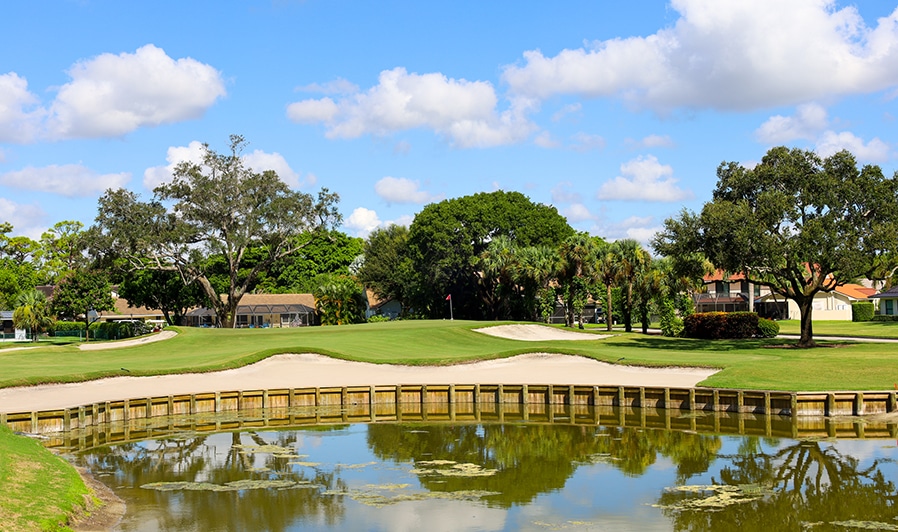
But there are no caddies – only just 27 holes of remarkably maintained golf. And perhaps that is exactly as it should be.
It was my second consecutive day playing golf, and for the second straight morning, Iencountered several par threes stretching between 215 and 230 yards from the back tees.
Naturally, because golf remains committed to the proposition that suffering builds character, many played directly into the prevailing wind. One suspects the architect was familiar with the concept that not every par three needs to be solved with an 8 iron and positive thinking.
The two nines we played that morning – South and North – proved consistently engaging. Each measured approximately 3,550 yards from the black tees, producing a robust championship routing of roughly 7,100 yards and a course rating of 74.3.
Entirely respectable, particularly given that this was my first encounter with the property, unfamiliar start lines off tees, uncertain visual corridors, and greens whose intentions reveal themselves slowly and without apology.
To post a number around course rating underthose conditions felt less like achievement and more like confirmation that the course asks questions worth answering.
The East Course was closed during my visit for refurbishment, though it adds another layer of fascination. At roughly 3,530 yards, including the property’s longest par three at a formidable 245 yards, the permutations become intriguing.
North/East yields approximately 7,080 yards. East/South yields virtually the same. Interesting symmetry. Almost symmetrical enough to remind one of Plato’s descriptions of Atlantis itself, arranged in concentric rings and geometric order. Whether intentional or coincidence scarcely matters. Golf has always enjoyed borrowing mythology.
But Lost City’s real defenses are elsewhere. Not in forced carries. Not in theatrical water hazards. Not in rough cultivated to resemble failed agricultural policy. The greens are the true guardians of Atlantis. Semi-raised and
beautifully contoured, they reveal themselves slowly. Knowing where the flag is located is only half the assignment. Understanding where the golf ball must first arrive in order to access that flag is the examination. Certain ridges repel. Others gather. Approach shots land with promise and roll quietly into disappointment. Miss the incorrect side and putting becomes archaeology.
Equally enjoyable were the options around the greens. Closely mown runoff areas offered genuine decisions. Putt. Chip. Bump-and-run. Invent. Golf as problem solving rather than punishment. A curious concept in modern architecture. No deep rough masquerading as challenge. No punishment disguised as strategy.
Instead, Lost City embraces one of golf’s oldest and increasingly endangered virtues, choice. And that realization became increasingly difficult to ignore. This was not simply a golf course situated inside a community. This golf course created the community.
To understand Lost City Golf Club, one must first understand Atlantis. Long before houses lined fairways and retirees debated property values, this land was cattle country. In 1958, developers Paul Kintz and Nathan Hunt purchased roughly 828 acres and proposed an idea that now seems almost impossibly quaint. Build the golf course first. Build the city around it. Not houses with amenities. Golf with houses. Construction began in the early 1960s with an inn, clubhouse, and 18 holes designed by William F. Mitchell.
Those original eighteen became today’s North and South nines. What followed was unusual. Roads bent around holes. Homes aligned with fairways. Views dictated values. Eventually the community incorporated. The City of Atlantis emerged. This sequence matters. Most cities acquire golf courses. Atlantis acquired a city.
The original Atlantis Country Club and Inn became the social and geographic center ofcommunity life. As demand increased, a third nine was added. Twenty-seven holes. One of Palm Beach County’s larger golf facilities. The expansion merely confirmed what had already become obvious. Golf was not an accessory to Atlantis. Golf was Atlantis. Residents did not live adjacent to the course. They lived because of it.
By the late 1960s, members pursued ownership themselves, eventually acquiring the club and securing stewardship from those most invested in preserving its character. Decades later, in 2016, the club adopted a new identity.
Lost City Golf Club. An inspired choice. Situated inside Atlantis, the name quietly acknowledges mythology without becoming hostage to it. The irony is difficult to miss. A hidden golf course in a city named after a hidden civilization. Sometimes symbolism writes itself. Then came modernization.
In 2021, Tom Fazio II led a renovation updating
greens, bunkers, tees, and infrastructure. Mercifully, the project resisted the modern temptation to erase history in pursuit of fashion. The best restorations reveal. They do not replace. Lost City remained itself. Which is perhaps why the place lingers. It is not famous. It hosts no major championships. It rarely appears in rankings. You will not find influencers discussing launch conditions from the seventh tee. And yet its historical importance is difficult to overstate.
Few golf clubs can credibly claim they shaped the creation of an entire municipality. Fewer still remain the living center of that community six decades later. Lost City remains what it has always been. The heart of Atlantis. And perhaps that is its greatest achievement.
In an age where golf increasingly confuses expense for excellence and spectacle for substance, Lost City offers something almost radical. A course that knows exactly what it is. A
city that remembers why it exists. And a piece of old Florida golf quietly hiding in plain sight.
Photo Credits: Lost City Golf Club