

Mountain Lake in Lake Wales, FL., is Frederick Law Olmstead, Jr.’s, master class in landscape planning. Created in 1915 – just four years after the founding of Lake Wales – Mountain Lake quietly spreads across 1,000 acres of subtly rolling Central Florida terrain. Combined with the genius of course architect Seth Raynor, the course, which opened in 1917, has a near-mythic reputation as one of the country’s finer examples of Golden Age golf, as well as Gilded Age society.
“A historic rollback in time,’’ Eric. J. von Hofen, the Club’s highly-respected COO/General Manager said of the course. “That’s what our members and our residents who live here really strive for. It’s the backbone of the whole identity of this property.’’
Tyler Rae’s mandate over the next few months is to restore Mountain Lake’s identity back as close as possible to Raynor’s original vision. The course has been through other tweaking and restoration projects in its nearly 110 years, first in the late 1920s by Raynor protege Charles Banks. Brian Silva followed in 2002 with work on the squaring off the bunkers and recontouring the greens; and in 2010, Ron Prichard also worked on reshaping the bunkers and greens.
Rae’s restoration, however, promises to be the most extensive to date. It’s a project he has coveted since he first saw Mountain Lake as a design associate with Prichard.
“I love being out here,’’ Rae said as he stood near Mountain Lake’s 18th green, with the Olmstead-designed Bok Tower peering over his shoulder. “You’re kind of one with nature.
“We’ve found some old bunker sand, which gives us validation. And we’ve found some old green shapes. The archeology is really fascinating.’’
The restoration plan also will focus on modernizing and improving the bunkers and greens. The bunkers will be updated and the Tif-Eagle Bermuda putting surfaces will be recreated to sizes, shapes and characterizations that were depicted in the historical photos.
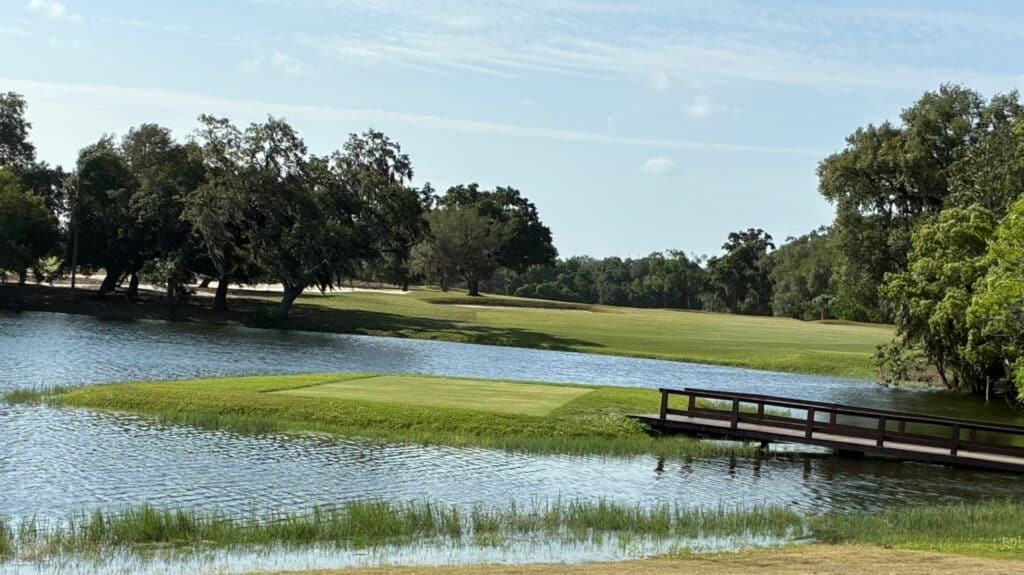
Seth Raynor’s famous island tee box on the eighth hole at Mountain Lake
Silva’s restoration project created attention because of his use of original aerial photographs to help determine the original sizes and shapes of Mountain Lake’s greens and bunkers. Rae, like Silva, a student of golf’s Golden Age of architecture, is going even farther, by using archival photos from the Club’s extensive library, along with newly discovered historic information about the course found in the Olmstead files at the University of Virginia, University of Florida and Brookline, MA.
Rae’s research gave him and Club officials access to historic information, such as Raynor’s 1915 sketch of the first nine holes; revision drawings from Banks that date to 1929; and engineering drawings from 1935 and 1941 aerials.
“At the University of Florida, I found a photo from 1924 of someone flying over the back nine,’’ Rae said.”It shows every single bunker on the course. When we showed that picture to some members, they said we hit a home run.’’
“It was all hands on deck going through everything,’’ said von Hofen. “When Brian Silva did the course, he didn’t have a lot of these files. There was a lot of interpretation to what everybody thought it should look like – or to what they believed the characteristics were. I think where we are now digitally… going back to look these files is just night and day ahead of where we were.”
Rae has restored other Raynor original designs – at Lookout Mountain (GA.) Club and Wanumetomony Golf and Country Club in Middletown, R.I. The Mountain Lake project is expected to be completed by October 2026.
Among the more notable restoration highlights: recreating the original punch bowl green at the third hole that was seen in Raynor’s 1915 routing and in early 1917 photos; reconfiguring the fairway bunkering at the fourth hole to match the design seen in Raynor’s 1915 routing. A large, dominant bunker on the left will replace the multiple ones currently found on that side, forcing golfers to decide how much they want to bite off from the tee; and restoring the fore bunker at No. 12 to create a dramatic visual from the tee and provide lines of play for golfers to aim their tee shots. This hole is a blind tee shot-a rarity in Florida. The 12th green will be rebuilt with a softened tier that runs through the middle of the green to create more flags and significantly improved playability; the 13th hole “Road Hole” fore bunkers will be recreated to promote strategy off the tee. A fairway bunker about 100 yards from the green also will be recreated, emulating the strategy and location of the Scholar’s / Progressing bunker complex on the original Road Hole at The Old Course at St. Andrews in Scotland.
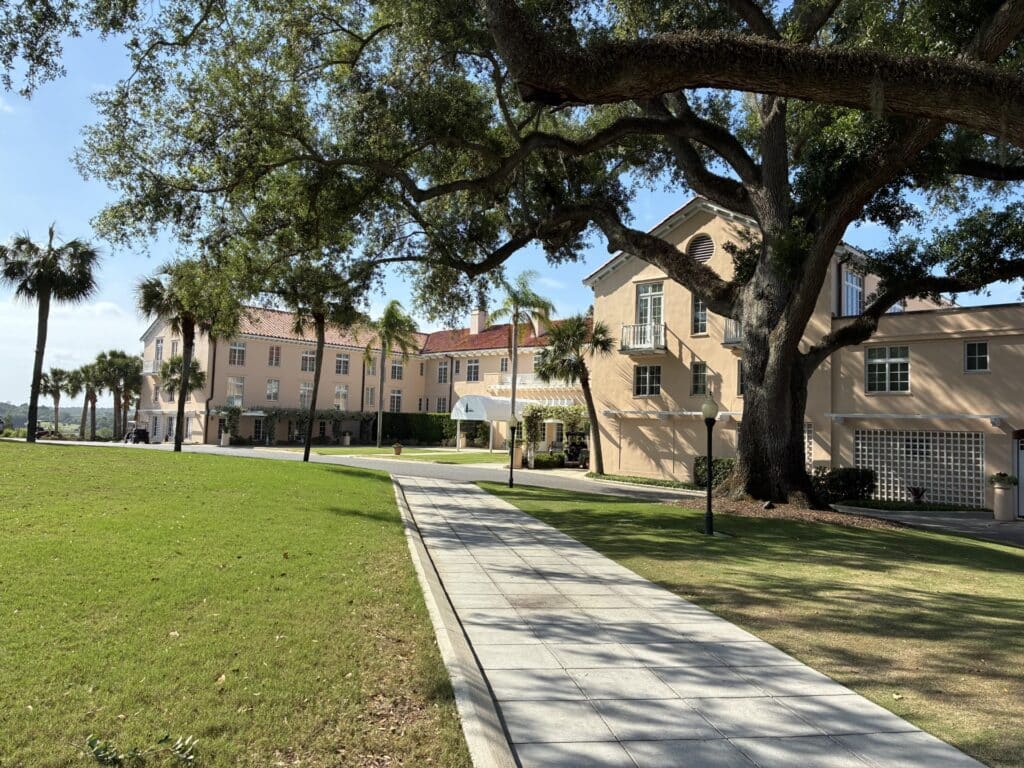
Colony House at Mountain Lake
Raynor’s original routing basically will remain intact, meaning the course (par 70) will play from slightly more than 6,700 yards from the back tees.
“The goal is not to become a championship test,’’ Rae said. “It’s to restore the strategy. This is a member’s course. They don’t want it easier or more difficult. We’re not going to make these bunkers 10 feet deep.
“I love working with the members here because they are passionate. They know how the course plays.’’
Standing outside of the Club’s signature 37-room Colony House (built in 1916), von Hofen scanned the landscape.
“There have been 385 holes of golf built in Florida in the past two-and-half years,’’ he said. “It’s amazing how many people have their eyes on us. There are a lot of people trying to create what we have. But it takes a ton of time and years and people to pull off something like this.’’
It takes something historic.