

In an interview (circa 1926) with the Tampa Tribune, Donald Ross explained his design philosophy behind the course at Whitfield Estates, now Sara Bay Country Club.
“We designed it,’’ the master said, “for golf.’’
On the surface, that’s like Carroll Shelby saying he designed the Ford GT40 to go fast. It’s a simple tenet, but one that only a few truly understand and achieve.
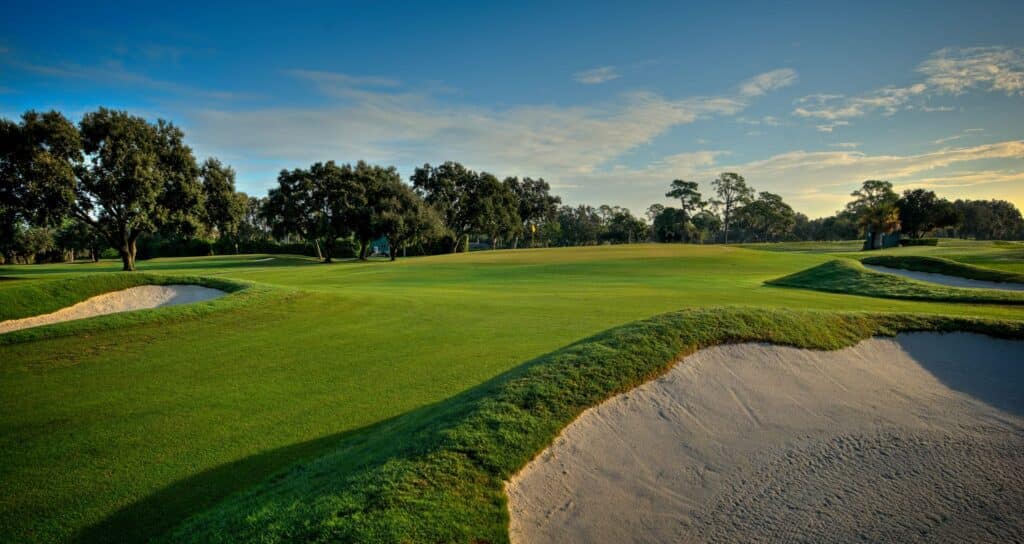
Sara Bay Country Club – on the north side of Sarasota, FL. – is a testament to each. Celebrating its Centennial year, the 7,106-yard, par 72 course is Ross at the top of his game, complete with inverted greens, wide, subtly-angled fairways and flashed greenside bunkers.
Simply stated, playing Sara Bay Country Club is what it means to “play golf.’’
“A lot of things make this golf course what it is – like the angles Ross used,’’ said Sara Bay General Manager John Spiess, a PGA Master Professional who came from The Country Club of Roswell (GA.) five years ago. “When we play, we tend to just look straight ahead and bomb it. But he has bunkers in positions that make a dogleg look straight.’’
The course has been tweaked and renovated over the years by a pair of Ross devotees, each of whom used original Ross drawings as their lodestar.
Brian Silva, in 1991, began a restoration that included adding new tee boxes and fairway and greenside bunkers. He also restored Ross’s trademark fall-off greens that had aged.
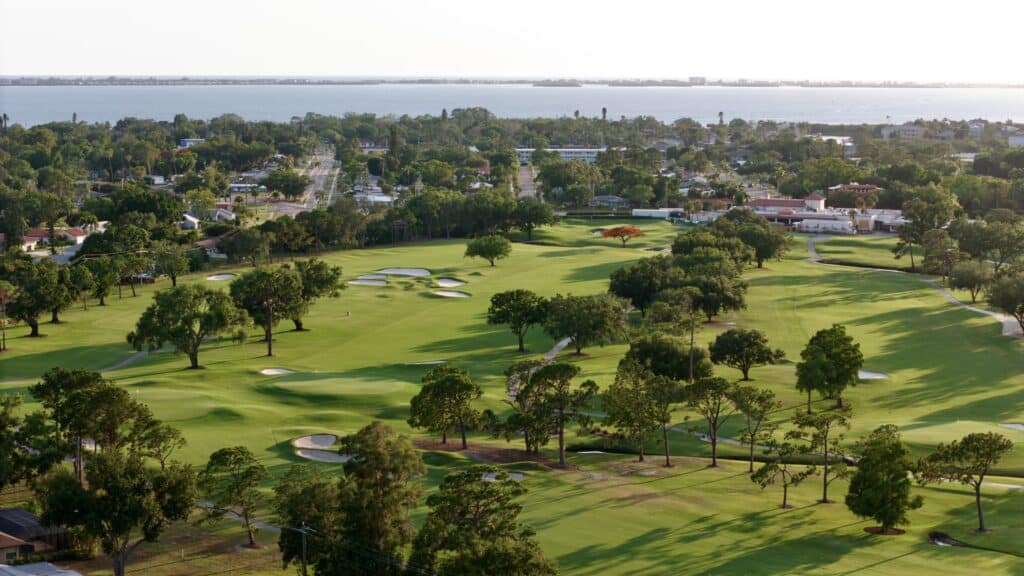
In 2018, Kris Spence oversaw a project that oversaw the reshaping and regrassing of the greens back to their original Rossian designs. Spence painstakingly redesigned the course true to the original Ross drawings, which were unearthed in a member’s attic. It’s that mounding, false fronts and roll-offs, that challenge the approximately 350 members at Sara Bay.
“We have a very passionate membership,’’ Ted Gilvar, Sara Bay membership chairman told me as we sat inside the trailer that’s serving as Sara Bay’s clubhouse until a multi-million-dollar clubhouse renovation project is complete in 2027. “They appreciate the history… whether they are scratch players or 20 handicaps. They are all serious golfers. It takes a certain amount of intestinal fortitude to play this course.’’
“It almost feels like a northern (U.S.) course. A lot of Florida courses are cookie-cutter – with doglegs and palm trees everywhere. This doesn’t feel like that. I grew up playing Ross courses like Salem (MA.) Country Club and Worcester (MA.) Country Club. This kind of reminds me of them.’’
Bobby Jones couldn’t have said it any better. In fact, Jones probably said words similar to that as he sold homes at Whitfield Estates, billed as the “Gateway to Sarasota,’’ in the city’s halcyon mid-1920s, while Tommy Armour served as the Club’s head professional and the likes of Babe Ruth walked its fairways.
“The ‘glory days’ of Sarasota,’’ Spiess said.
That’s when the circus came to town – literally and figuratively. Ringling Brothers, in 1927, moved its winter home to Sarasota. Also in 1927 – Feb. 28 to be exact – Walter Hagen came to town. Arguably the most famous (and flamboyant) professional golfer in America’s “Golden Age’’ of sports, by February of 1927 Hagen had won two U.S.Opens, two British Opens and four PGA Championships.
During that same period, Jones – well on his way to becoming the most celebrated amateur in golf history – had won two U.S. Opens, two U.S. Amateurs and one British Open.
Tickets for the first act of the 36-hole “Match of Century’’ at Whitfield Estates Country Club between 24-year-old Jones and 34-year-old Hagen, were $3.30 each. Newspaper reports claimed as many as 2,000 people watched Hagen beat Jones 8-up. The second part of The Match continued a few weeks later with Hagen finishing off Jones by winning 12 holes with 11 to play at Pasadena Yacht & Country Club in nearby St. Petersburg, where Hagen was its first club professional.
“At that time professional golf was looked down on,’’ Spiess said. “When Jones lost, people said, ‘These pros are pretty good.’’’
Indeed, big time golf had come to Sarasota. The local newspaper declared the city among “the leading golf centers’’ in the country.
Judging from the number of golf courses and golf communities that now populate the area, that decree has proven to be correct. But life after “The Match’’ wasn’t all a ray of Florida sunshine for Whitfield estates. While Hagen and Jones each went on to become legends, the Club closed for a few years in the 1930s and came back under a number of names before settling on Sara Bay Country Club in 1964.
Beyond The Match, the Club’s history includes being the site of the PGA Senior Championships in 1940 and 1941, as well as the LPGA Sarasota Open from 1952-54 and the Symetra Sara Bay Classic from 2012-17.
Nelly Korda, the world’s top-ranked female player and winner of the 2026 U.S. Women’s Open, is a member of Sara Bay.
As part of that commitment to celebrating its history, Sara Bay is retaining the exterior of the 1920s Spanish Renaissance-style clubhouse, which sits on a pine-topped knoll selected by Ross so it would command the view and look over the first tee and final green.
A bust of Ross – one of only 13 in existence – graces the clubhouse’s hallway entrance. Another is above the fireplace at Ross’s beloved Pine Crest Inn in Pinehurst, N.C.
If you listen close, you might hear him say, “Time to play golf.’’
Photos Courtesy of Sara Bay Country Club